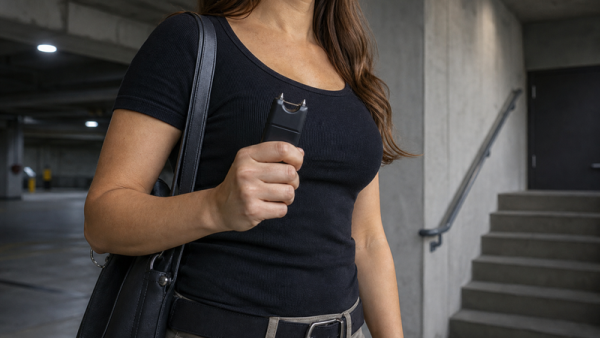
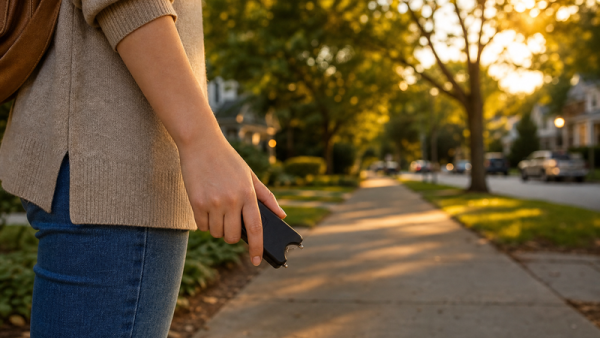
The best stun gun for running is small enough to disappear in your hand, secured with a wrist strap or armband so it can’t slip during a sprint, and legal to carry in your state (stun guns are legal in most states but restricted in a handful — always check local law before you buy). Look for something under 5 ounces with a non-slip grip, because a device you can’t hold onto at mile three isn’t protection — it’s a liability.
Why does running alone still feel different than it should?
You know the feeling. You lace up, plug in your earbuds, and there’s this small calculation running in the back of your mind the entire time — which streets have streetlights, what time the sun actually sets, whether that car idling at the corner is just parked or watching. You shouldn’t have to think about any of that. But you do, and pretending otherwise doesn’t make you safer. It just makes you unprepared.
This isn’t about fear. It’s about the fact that running is one of the few times a day you’re truly alone, moving, and vulnerable in a way you’re not when you’re in your car or at your desk. Your hands are already busy — earbuds, phone, water bottle. Whatever you carry for protection has to work with your body, not against it. That’s the whole challenge with stun guns for runners: most weren’t designed with a moving, sweating, out-of-breath person in mind. This post is about finding the ones that were.
What makes a stun gun actually practical for running?
A stun gun is practical for running when it stays attached to you, not your bag or your car console. That means a wrist strap or armband, not a device you have to dig for in a fanny pack while your heart rate is already at 160.
Three things separate a runner-practical stun gun from one that’ll just get left in a drawer:
- Attachment method — A stun gun with a wrist strap stays on your body through every stride, every turn, every moment you’re not thinking about it. That’s the point. You shouldn’t have to think about it to have it.
- Grip texture — Sweaty palms and smooth plastic are a bad combination. Look for rubberized or textured housing.
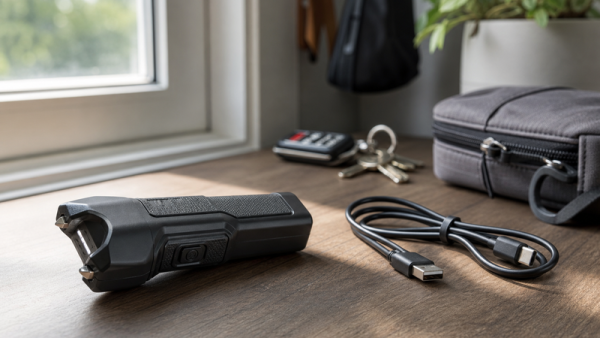
- Weight — Anything over 6-7 ounces starts to feel like dead weight bouncing against your wrist by mile two. The lighter models built for everyday carry, like a lipstick stun gun, were designed for exactly this kind of discretion and portability.
Here’s the honest truth: a stun gun sitting in a nightstand drawer has never protected anyone. The one that matters is the one that’s actually on your body when you need it — and for runners, that almost always means a wrist strap or armband setup, not something you’d have to stop and unzip a pocket for.
What’s legal to carry while running?
Stun guns are legal for civilian self-defense use in most states, but a few states and cities restrict or ban them outright, and some have age or permit requirements. This isn’t something to guess about — the laws vary enough by state and even by city that what’s fine in one town might not be fine twenty miles away.
Before you buy anything, take ten minutes and check your state’s specific stun gun laws, and if you travel or run in multiple jurisdictions for work or races, check those too. This matters more for runners than almost anyone else, because running routes often cross town lines without you noticing — a loop that starts in your neighborhood might end up in a different municipality with different rules.
If you want to understand how stun guns compare legally and functionally to other options like TASER-branded devices, our breakdown on TASER vs. stun gun for self-defense covers the differences in range, cost, and legal classification that matter before you commit to either.
What size and shape actually works mid-stride?
The devices that work best for runners are compact, narrow enough to close a fist around completely, and shaped so there’s no learning curve under stress. You will not have time to figure out which end is which if something happens — your hand needs to know before your brain does.
This is where a lot of stun guns fail runners specifically. Bulky models designed for glove compartments or purses often have wide bodies that are hard to grip one-handed while you’re already holding your phone or a water bottle. Compact models built into everyday-carry shapes — think the size and profile of a small flashlight or cosmetic case — solve this. They’re not just about being discreet; they’re about being usable without fumbling.
Runners who carry on their hip or waistband instead of their wrist often prefer a stun gun with a nylon holster, which keeps the device secured and quick to draw without needing to hold it through an entire run. It’s a different approach than the wrist strap method, and honestly, which one works for you comes down to your own running style — some people hate anything on their wrist, others hate anything on their waistband. There’s no wrong answer here, just the one that means you’ll actually wear it.
How does a stun gun compare to other options runners carry?
Stun guns require direct contact, while pepper spray works at a distance — and for runners, that distance matters more than almost any other user group. If someone is closing in on you while you’re running, you may have a few seconds of space between you and them. Pepper spray uses that space. A stun gun requires you to close it, which isn’t always the safer choice depending on the situation.
That said, plenty of runners carry both, because the two tools solve different problems. A stun gun gives you something decisive for close-range encounters — someone who grabs you, someone in your immediate space. Pepper spray gives you range. If you’re curious about how pepper spray holds up over time in a gym bag or running belt where it sits for months, our post on whether pepper spray expires is worth a read before you assume the canister from two years ago is still good.
For runners who commute by foot to work or run the same route to a train station, the same logic that applies to stun guns for commuters applies here too — you want something built for repetitive, predictable movement, not a single dramatic moment.
Does a stun gun actually work if someone grabs you mid-run?
Yes — a properly charged stun gun applied to large muscle groups can disrupt an attacker’s ability to continue an assault, typically within one to five seconds of contact, giving you the window to get away and keep running toward safety. That window is the entire point. You’re not trying to win a fight. You’re trying to create enough separation to do the thing your body is already built to do — run.
This is worth sitting with for a second, because it’s the actual heart of why this matters. You already have an advantage most people in a confrontation don’t: you’re a runner. You have endurance, you have momentum, and you likely know your route better than anyone following you does. A stun gun doesn’t need to end an encounter. It just needs to buy you the two or three seconds most attackers aren’t expecting to lose. If you want a deeper, no-hype look at what the research actually shows about effectiveness, we’ve covered it directly in what research really shows about electric self-defense and in our related piece cutting through the marketing noise on whether stun guns are actually effective for self-defense.
Frequently Asked Questions About Stun Guns for Runners
Can I run with a stun gun in my hand the whole time?
You can, but most runners find it easier and more secure to use a wrist strap or armband instead. Holding a device for an entire run increases the chance you’ll drop it, especially once your hands start sweating or you need to adjust your pace, wipe your face, or grab water.
Are stun guns legal to carry while jogging in public?
In most states, yes — stun guns are legal for adults to carry for self-defense. A handful of states and cities restrict or ban them, so check your specific state and local laws before purchasing, especially if your running route crosses city or county lines.
What’s the best stun gun for someone who runs with a phone and no pockets?
A wrist-strap model is generally the best fit here, since it doesn’t require pocket space and stays secured to your body without needing to be held. Some runners pair it with an armband that holds both the phone and the stun gun together.
Will a stun gun still work if I’m sweaty or it gets rained on?
Most stun guns are built with weather-resistant housing that handles sweat and light rain fine, but they’re not fully waterproof. Avoid submerging one or running through a downpour without some kind of light cover if you want to protect the internal electronics long-term.
How much does a stun gun weigh, and will I feel it while running?
Compact runner-friendly stun guns typically weigh between 3 and 7 ounces, which is comparable to a small water bottle or a phone. Most runners report barely noticing it once it’s secured properly on a wrist strap or armband.
Should I get pepper spray instead of a stun gun for running?
Many runners carry both since they solve different problems — pepper spray works at a distance, while a stun gun requires contact but can be more decisive once someone is in your space. Your choice should depend on your typical running environment and personal comfort level with each tool.
How do I know if a stun gun is actually charged before I head out?
Most models have a small indicator light that shows charge status, and it’s worth testing before every run, especially if you haven’t used it in a few days. Making this part of your pre-run routine — same as checking your shoelaces — takes ten seconds and removes any guesswork.
Can I bring a stun gun on a running trip to another state?
You’ll need to check the laws of every state you’ll be running in, since legality varies and some states have outright bans or restrictions that don’t exist where you live. This is especially important for race travel or vacations where you might not think to check ahead of time.
Your run, your route, your call
At the end of the day, this isn’t really about the device. It’s about the fact that you love running enough to keep doing it, even on the mornings when the sky’s still dark and even on the routes that make you a little more alert than others. That instinct to protect the thing you love doing — that’s not paranoia. That’s just you taking care of yourself the same way you’d take care of anyone else you loved.
Whatever you end up choosing, choose something you’ll actually wear, not something that sits in a drawer because it didn’t fit your hand or your routine. If you’re not sure where to start, our guide to the best rechargeable stun guns for women is a good next stop — small, dependable options that were built for real bodies doing real things, not just sitting on a shelf.