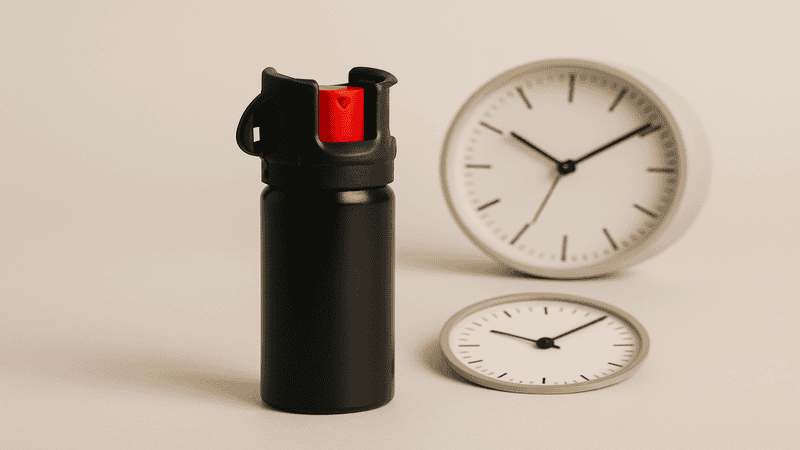
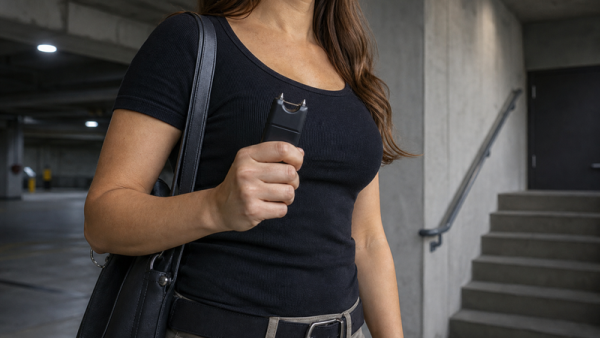
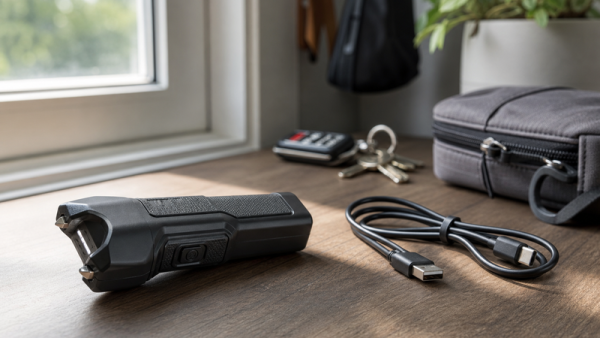
Yes, pepper spray expires — and it matters more than most people realize. Most canisters carry a manufacturer-recommended shelf life of 2–4 years. After that, the propellant loses pressure, the OC concentration can degrade, and what you thought was protection may not perform the way you need it to. Check the expiration date on your canister. If you don’t see one, or if it’s been more than two to three years, it’s time to replace it.
Why does pepper spray have an expiration date in the first place?
This is a fair question, and it deserves a straight answer. Pepper spray isn’t like a carton of milk that suddenly goes bad on a specific day. The expiration date is the manufacturer’s honest assessment of when performance starts to become unreliable — not a hard cliff edge, but a meaningful threshold.
Two things degrade over time inside a sealed canister. First, the propellant — the pressurized gas that drives the spray out with enough force to reach a threat at a distance. Aerosol canisters lose pressure gradually. An older canister may spray weakly, dribble instead of stream, or stop mid-deployment. Second, the active ingredient itself — oleoresin capsicum (OC), derived from hot peppers — can break down over time, especially when exposed to heat fluctuations. The concentration and potency that was tested and certified by the manufacturer at production may be meaningfully reduced two or three years later.
Neither of those degradation processes announces itself. The canister looks the same. The safety clip is still in place. You’d have no way of knowing there’s a problem until the moment you needed it to work — and that’s the wrong time to find out.
How long does pepper spray actually last before it should be replaced?
Most manufacturers print a shelf life of 2–4 years on the canister, and that range reflects real testing of propellant pressure and OC potency over time. Brands like Mace, Wildfire, and Pepper Shot — all carried here at Revere Security — follow industry-standard dating practices, and you’ll find an expiration date stamped on the bottom or side of the canister.
That said, how you store pepper spray has a direct impact on how close it gets to that full shelf life. A canister stored at relatively stable room temperature in a dry location will hold up better than one that’s been sitting in a hot car through several summers. Heat accelerates the degradation of both the propellant and the OC formula. Cold does too, to a lesser extent — extreme cold can affect spray consistency temporarily, though it usually recovers at room temperature.
A practical rule of thumb: check your pepper spray twice a year — when you change your smoke detector batteries is an easy way to remember. Look at the expiration date. Look for any visible damage to the canister. And if it’s been riding in a hot glove compartment for two years, treat it as expired regardless of what the label says. If you keep pepper spray in your car, this is especially worth paying attention to.
What happens if you use expired pepper spray on an attacker?
Here’s the honest answer: it might still work, partially. But “might still work, partially” is not a standard you want to bet your safety on.
An expired canister with reduced propellant pressure may produce a weak stream that doesn’t reach the distance you’re counting on — most pepper sprays are tested to perform at 8 to 12 feet. If yours only reaches 3 feet, you’ve closed the distance between you and a threat in a way that creates new problems. A degraded OC formula may cause irritation but not the strong incapacitation — the involuntary eye closure, intense burning, and respiratory distress — that gives you the critical seconds to get away.
The purpose of pepper spray isn’t to cause pain. It’s to create enough of a physiological response that you have time to put distance between yourself and a threat. An expired canister that delivers an underwhelming result does not accomplish that goal reliably. Replacing a canister that’s $15–$20 is not a significant investment compared to what you’re counting on it to do.
How do you check if your pepper spray is still good?
Start with the expiration date. It’s usually stamped, embossed, or printed on the bottom of the canister. If you genuinely can’t find one, contact the manufacturer — most will tell you the production date if you provide a lot number. Without any date information, a conservative approach is to replace it if you’ve had it for more than two years or don’t know how long you’ve had it.
Beyond the date, here’s what to look for:
- Visible rust or corrosion on the canister or nozzle — a sign of moisture exposure that can compromise the seal
- Nozzle damage or clogging — residue from a previous test or accidental discharge can block the spray pattern
- Dents or deformation — physical damage can affect the pressure seal
- The safety mechanism — make sure it moves properly and hasn’t become stuck or corroded in place
Some manufacturers recommend doing a very brief test spray (one-quarter second burst) outdoors and downwind once a year to confirm pressure and function. This is reasonable if done carefully — away from people, animals, and any space you’ll be entering — but it does consume a small amount of product. If your canister is already older than two years, a test spray that produces a weak stream is your answer: replace it.
Where you store pepper spray changes how long it stays reliable
Storage is one of the most overlooked factors in pepper spray shelf life, and it’s worth spending a moment on because the right habit here is simple.
Heat is the main enemy. Temperatures above 120°F — easily reached inside a parked car in summer — accelerate propellant loss and OC degradation. If your canister lives in your car year-round, in direct sun, in a warm climate, shorten your replacement cycle accordingly. Every summer, it’s worth pulling it out and replacing it as a matter of routine.
Moisture is the second concern. A bathroom cabinet or a damp basement shelf isn’t ideal. The canister itself may be sealed, but prolonged moisture exposure can cause corrosion around the valve and nozzle that affects deployment.
The best storage spots are cool, dry, and accessible. A bedside drawer, a jacket pocket, a clipped position on a bag or belt — these work. A belt clip pepper spray kept on your person during daily activities is both well-stored and actually available when you need it, which addresses the second half of the reliability equation: having it with you matters as much as it being in good condition.
Does the type of pepper spray formula affect how long it lasts?
Somewhat, yes. The base formula — gel, foam, stream, or cone/fog — doesn’t dramatically change the shelf life, since the propellant degradation timeline is similar across formats. However, gel and foam formulas tend to have a slightly more stable OC concentration over time because the thicker base medium is less prone to separation or settling than standard liquid formulas.
What matters more than the delivery format is OC concentration and heat (SHU) rating. Higher-concentration formulas from reputable brands are tested for potency at time of manufacture. Whether that concentration holds over time is a function of storage and age — not the format alone.
Streetwise and Wildfire — two brands we carry — offer high-OC-concentration formulas that are a step above baseline. If you’re replacing an older canister and want to ensure you’re starting with a strong product, these are worth considering. Pepper spray for home defense scenarios, in particular, benefits from a higher-concentration formula since you may have slightly more time to deploy it deliberately than in an on-the-go situation.
How often should you replace pepper spray as a routine matter?
The clearest, most honest guidance: replace it every two years as a baseline, regardless of whether it has technically expired. If your storage conditions are harsher than average — a car in a warm climate, a range bag that goes from hot to cold regularly — replace it annually.
Think of it like a smoke detector battery. The battery may not be completely dead when you swap it. That’s fine. You’re replacing it because the consequence of it failing at the wrong moment is not acceptable. The same logic applies here.
For people who carry pepper spray as a regular part of their daily routine — and this is especially relevant for anyone using pepper spray as an elderly person’s defense option, or for security professionals who carry it on shift — building replacement into a routine removes the guesswork. Buy a replacement when you open a fresh canister. Keep it on a shelf. When the two-year mark arrives, swap and rotate. It costs less than a dinner out and takes thirty seconds.
Frequently Asked Questions About Pepper Spray Expiration and Shelf Life
Does pepper spray actually expire or is it just a manufacturer recommendation?
It’s both. The expiration date reflects the manufacturer’s tested threshold for reliable performance — specifically, the point at which propellant pressure and OC concentration can no longer be guaranteed to meet labeled specifications. It isn’t arbitrary. After that date, deployment distance may decrease and the incapacitating effect may be weaker. Replace it on schedule and treat it as a real expiration, not a suggestion.
How can I find the expiration date on my pepper spray canister?
Most manufacturers stamp or print the expiration date on the bottom of the canister or along the lower edge of the label. Some use a production/lot date code rather than a printed expiration date. If you can’t locate a date, contact the manufacturer with any lot number or code you find on the canister. When in doubt, if you’ve had it for more than two to three years, replace it.
Is it dangerous to use expired pepper spray?
It’s unlikely to cause harm to you under normal use, but it may fail to protect you effectively. Reduced propellant pressure can result in a weak or short-range spray. Degraded OC potency may cause irritation instead of the strong incapacitation you need. The risk isn’t physical danger from using it — it’s relying on it and having it underperform in a situation where you needed it to work fully.
Will pepper spray expire faster if I keep it in my car?
Yes. Heat is the primary accelerator of both propellant loss and OC degradation. A canister stored in a vehicle that reaches high temperatures regularly — especially in warm climates or direct sun — should be replaced more frequently than the standard two-year guideline. If your car routinely gets very hot in summer, treat vehicle-stored pepper spray as a one-year item rather than a two-to-four year item.
Can I test my pepper spray to check if it still works?
A brief test spray — about one-quarter second — outdoors and well downwind can tell you something useful about pressure and spray pattern. If it produces a strong, consistent stream or cone, propellant pressure is probably still adequate. If it dribbles or sprays weakly, replace it. Do this with extreme care: keep wind direction in mind, stay away from people and animals, and don’t re-enter any enclosed space until the area has cleared. Never test indoors.
Does the strength (SHU/OC percentage) affect how long pepper spray stays effective?
The OC concentration and SHU rating at manufacture don’t significantly change the rate of degradation — both high- and standard-concentration formulas follow similar timelines. What matters more is storage conditions and time. That said, starting with a higher-concentration formula from a reputable brand means you have more margin before degradation reaches a level that meaningfully affects performance. Quality matters at the starting point.
Should elderly users replace pepper spray more often?
For anyone who depends on pepper spray as a primary personal safety tool — including older adults — replacing it on a strict schedule is especially important. There’s less margin for a partially-degraded product to compensate. A fresh canister every two years, stored in a cool dry location and carried consistently, ensures the product performs as expected. An easy-to-grip, clearly-labeled canister specifically designed for ease of use is also worth prioritizing over a general-purpose option.
What’s the difference between OC percentage and SHU in pepper spray?
OC percentage refers to the concentration of oleoresin capsicum in the formula — how much of the spray is the active pepper extract. SHU (Scoville Heat Units) measures how hot that extract actually is. A spray with 2% OC from a high-SHU source can be more potent than one with 10% OC from a weaker source. Both numbers matter. Reputable brands test and certify the heat rating of the OC they use, so you’re not just buying a number — you’re buying tested performance.
Your pepper spray is only useful if it works when you need it. That means checking the expiration date, storing it somewhere stable, and replacing it on a reliable schedule — not when you happen to remember. Two years is a good default. One year if it’s been through some heat. These are small habits that keep your protection genuine rather than just theoretical.
If you’re ready to check your current canister and realize it’s time for a fresh one, browse our full selection of pepper spray options at Revere Security. If you’re not sure which type fits your situation — for professional use, for home, for daily carry — take a look at our guide on how to use pepper spray for self-defense for context on what you’re actually selecting for. Getting the right tool, fresh and ready, is what prepared looks like.