No, you cannot carry a knife in your carry-on bag through airport security. The TSA prohibits all knives — including folding knives, pocket knives, and multitools with blades — from carry-on luggage. Your knife must be packed in checked baggage, properly sheathed or wrapped to prevent injury to baggage handlers, or it will be confiscated at the security checkpoint. There are no blade length exceptions for carry-on bags.
That answer is clear. But here’s where it gets personal — and where most people run into trouble. It’s not usually a matter of not knowing the rule. It’s a matter of forgetting. That favorite EDC knife for men that lives clipped to your pocket every single day? The one you’ve carried so long it feels like part of your hand? You forget it’s there. You walk through your morning, grab your bag, head to the airport — and then you’re standing at the security bin watching a TSA officer hold up the blade you’ve carried for three years.
That moment stings. Not just because of the cost, but because that knife meant something to you. This post is here to make sure that doesn’t happen.
Why do so many people lose their knives at airport security?
It’s almost never intentional. The people who lose knives at TSA checkpoints aren’t trying to smuggle weapons — they’re people who carry every day, who have built a routine around having a blade on them, and who simply didn’t stop to think before heading to the airport. That’s the nature of a good EDC knife. It becomes invisible to you. It becomes part of your rhythm.
The TSA reports that officers confiscate hundreds of thousands of prohibited items every year, and knives are consistently near the top of that list. Pocket knives, folding knives, small fixed blades, multitools — all of them flagged, all of them surrendered, most of them never coming home.
And the loss isn’t just financial. For a lot of people who carry, a knife represents something. It’s a mindset. It’s the decision to be prepared, to be capable, to handle whatever the day throws at you. Losing that blade to a plastic bin at a checkpoint can feel like a small defeat — especially when it was completely avoidable.
What exactly does the TSA say about knives in carry-on bags?
The TSA’s position is simple and absolute: no knives in carry-on baggage. Period. This includes folding knives of any blade length, fixed-blade knives, multitools that contain blades, Swiss Army knives, box cutters, and utility knives. There is no “under 2.5 inches” exception for carry-on bags — that rule was eliminated in 2013 after a brief policy reversal, and it has not come back.
The only knife-like items that get through are round-bladed butter knives. That’s the full list of exceptions.
What you CAN do is pack your knife in checked baggage. The TSA requires that knives in checked bags be sheathed or securely wrapped to prevent injury to baggage handlers. They do not need to be locked in a hard case, though some airlines may have their own requirements — it’s worth checking directly with your carrier before you fly.
If you’re carrying an assisted open pocket knife, the same rules apply. The mechanism doesn’t change the classification. Any knife goes in checked baggage or stays home.
What happens if TSA finds a knife in your carry-on?
This is where the story gets expensive — emotionally and financially. When a TSA officer finds a prohibited knife in your carry-on, you typically have a few options. You can voluntarily surrender the item (it gets confiscated, no exceptions, no returns). You can go back out through security and check the bag — which means going to the ticket counter, paying a bag fee if you didn’t already have a checked bag, and potentially missing your flight. Or in some airports, you can use a mail kiosk to ship the item to yourself — though these are not available everywhere and often charge a premium.
Most people surrender the knife. And most people are genuinely upset about it, not because they’re dangerous, but because they simply forgot. That moment of realization — reaching into a bin and seeing the item you carry every day flagged under fluorescent lights — is one that stays with you.
There’s also a civil penalty exposure in certain cases, though TSA generally treats honest mistakes with discretion. Still. It’s not a situation you want to be in at 5 a.m. before a business flight.
How should I pack a knife in checked baggage the right way?
Packing a knife correctly in checked luggage is genuinely simple — it just requires intention. Here’s how to do it right:
First, sheath the blade. If your knife has a sheath, use it. If it doesn’t, wrap the blade securely in a thick cloth, bubble wrap, or tape it closed so it cannot open during transit. The goal is protecting baggage handlers from an accidental cut — not hiding the knife.
Second, place it in the interior of your checked bag, not in an exterior pocket where it might be accessed during handling. You don’t need a locked case for most knives, but if you’re traveling with a higher-value blade, a hard-sided case inside your luggage is smart protection.
Third — and this is the part that matters most — build the habit of consciously moving your knife to checked luggage before you leave for the airport. Not in the parking garage. Not at the curb check-in. Before you leave home, when you’re calm and thinking clearly. That’s when the mistake gets prevented.
For travelers who carry regularly, the ritual matters. The same care you put into choosing a quality knife for everyday carry deserves the same care when you’re navigating travel.
Are there any self-defense tools I can carry on an airplane?
This question comes from the right place — the instinct to stay prepared doesn’t disappear just because you’re boarding a plane. And there are legal options, though they’re limited.
Personal alarms are permitted in carry-on bags. A compact, loud personal alarm doesn’t trigger TSA’s prohibited items list, and it gives you a meaningful deterrent tool that requires no training and raises no flags at the checkpoint. If you rely on a blade for peace of mind during travel and need to leave it in checked luggage or at home, a personal alarm in your carry-on is a reasonable replacement for the duration of the flight.
Pepper spray is technically allowed in checked baggage under specific conditions — no more than 4 fluid ounces, with no more than 2% Major Capsaicinoids — but it is prohibited in carry-on bags entirely. Never pack it in your carry-on.
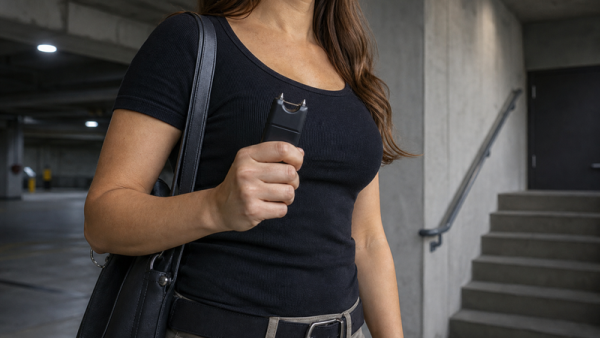
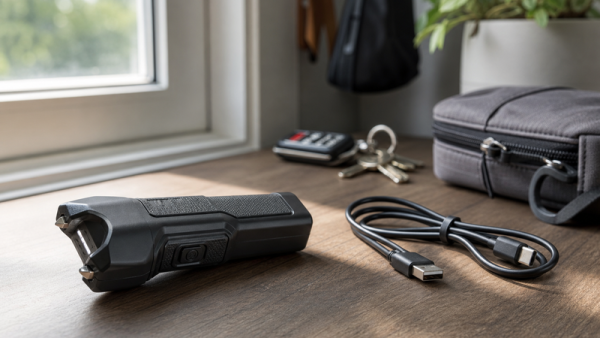
Stun guns and TASER devices are allowed in checked baggage but not in carry-on bags. Check your airline’s specific policies as well, since carriers can be more restrictive than TSA minimums.
The reality is this: once you’re on a plane, your options narrow. Being aware of your surroundings, choosing an aisle seat, knowing where exits are — situational awareness is the one tool that never gets confiscated. Our post on how personal alarms can keep you protected on the go has more on building a portable safety kit that travels with you.
What’s the best way to make sure I never lose a knife at the airport again?
The people who never lose a knife at a checkpoint aren’t less forgetful — they’ve just built better systems. Here’s what actually works:
Designate a travel EDC. Keep a separate, lower-cost knife that you allow yourself to pack in checked luggage without anxiety. Your best blade stays home. Your travel knife goes where it can go safely. This one habit prevents a lot of grief.
Use a pre-travel checklist. It sounds basic. It works. Before any trip involving a flight, run through what’s in your pockets and your bag explicitly. Not passively — actively. “Do I have a blade on me?” is a question worth asking out loud.
Put your knife in checked luggage first. If you’re bringing it, move it to checked baggage before you pack anything else. When the knife is already in the right bag, the risk disappears.
If you’re uncertain about whether a specific tool qualifies as a prohibited item, the TSA has an online “What Can I Bring?” search tool that gives item-specific guidance. It’s not exciting reading, but it’s saved a lot of knives.
Frequently Asked Questions About Carrying a Knife on an Airplane
Can I bring a pocket knife in my carry-on bag?
No. The TSA prohibits all knives from carry-on baggage, regardless of blade length or folding mechanism. This includes pocket knives, folding knives, assisted-open knives, and multitools with blades. There are no size exceptions. Any knife must be packed in checked baggage, properly sheathed or wrapped, or it will be confiscated at the security checkpoint.
Can I pack a knife in my checked luggage?
Yes. Knives are allowed in checked baggage as long as they are sheathed or securely wrapped to protect baggage handlers from injury. You don’t need a locked hard case for most knives, but checking your specific airline’s policies is smart before you fly. Pack the blade in the interior of your bag, not in an exterior pocket.
What happens if TSA finds a knife in my carry-on bag?
You’ll be given options: voluntarily surrender the knife (it won’t be returned), take it back through security to check a bag (which may cost a bag fee and could cause you to miss your flight), or in some airports, mail it to yourself via a kiosk service. Most people end up surrendering the item. TSA generally treats honest mistakes with discretion, but there is civil penalty exposure in some cases.
Is a Swiss Army knife allowed on a plane?
A Swiss Army knife with a blade is not allowed in carry-on bags — the blade classifies it as a prohibited item regardless of size or other tools on the device. A bladeless Swiss Army-style tool (scissors under 4 inches, files, etc.) may be allowed, but any version with a blade must go in checked luggage. Check the TSA’s “What Can I Bring?” tool for your specific model.
Can I carry pepper spray on an airplane?
Pepper spray is prohibited in carry-on bags entirely. In checked baggage, it is allowed under specific conditions: the container must be no larger than 4 fluid ounces and must have a safety mechanism to prevent accidental discharge. It must also contain no more than 2% Major Capsaicinoids. Never pack it in a carry-on — this one is enforced consistently.
What self-defense tools can I legally bring in a carry-on bag?
Personal alarms are permitted in carry-on bags and are one of the few personal safety tools that clear TSA without issue. Stun guns, TASER devices, pepper spray, and knives are all prohibited from carry-on luggage. For air travel, a personal alarm in your bag and situational awareness are your best in-flight safety tools. Check TSA guidelines before assuming any device is permitted.
Can TSA confiscate my knife permanently?
Yes. When you surrender a prohibited item at a TSA checkpoint, it is not held for you, stored, or retrievable later. It’s gone. Some airports partner with organizations that donate surrendered items, but you have no right to reclaim it after it’s been surrendered. This is why building a pre-travel checklist and designating a separate travel knife are habits worth developing.
Are multitools allowed on airplanes?
Multitools that contain a blade are prohibited from carry-on bags and must go in checked luggage, treated the same as any knife. Multitools that do not contain a blade — pliers-only versions, for example — may be permitted in carry-on bags. Check the TSA’s website for your specific tool. When in doubt, pack it in your checked bag and remove the uncertainty entirely.
Here’s the thing about carrying — it’s about intention. The people who are most prepared aren’t the ones who never run into rules. They’re the ones who know the rules cold, plan around them, and never let a security checkpoint catch them off guard. Knowing that your knife belongs in checked luggage isn’t a limitation on your preparedness. It’s part of being genuinely prepared.
If you’re building out an everyday carry setup — whether for travel or daily life — browse our full selection of knives for everyday carry. And if you want a deeper look at how self-defense information (and misinformation) actually works, our post on what self-defense content on the internet actually gets right and wrong is worth your time.