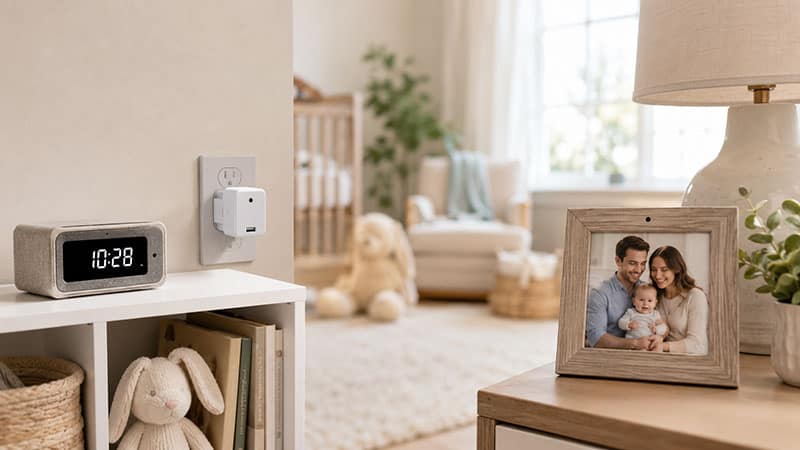
The most discreet nanny cams aren’t the ones you stumble onto by accident — they’re built from the ground up to live inside objects no one thinks twice about, like clocks, picture frames, and USB chargers, with lenses small enough to disappear into a surface that already belongs in the room. The difference between “hidden” and “hidden by design” comes down to lens placement, housing material, and whether the object would raise a single question if someone picked it up and turned it over. That distinction is exactly what separates a camera that actually protects your family from one that gets discovered in a week.
What makes a nanny cam actually discreet — not just small?
Here’s what most people get wrong: they assume “hidden camera” means “tiny camera.” It doesn’t. A camera can be small and still look wrong the moment someone picks it up — a lens hole that doesn’t match the object’s function, a seam that shouldn’t be there, a weight that feels off. True discretion isn’t about size. It’s about intention. Every detail of the housing has to answer a question before anyone thinks to ask it.
The best-designed devices start with the object, not the lens. Engineers pick something that already belongs in a nursery, a kitchen, or a home office — a clock, an air freshener, a phone charger — and then figure out how to fit a functioning camera inside it without changing how it looks, sits, or works. If a device still functions as the object it’s pretending to be, nobody has a reason to look twice. That’s the whole game.
This is why nanny cams built with true dual-purpose functionality outperform devices that are obviously repurposed electronics with a lens glued on. The ones that hold up under scrutiny are the ones where the disguise was the starting point of the design — not an afterthought.
Where do people usually give away a hidden camera without meaning to?
It’s rarely the camera itself. It’s what’s around it. A clock that’s suddenly the only object in the room facing directly at the crib. A picture frame with no photo in it. A charger plugged into an outlet that never gets used for anything else. The camera can be flawless — the placement gives it away every time.
Most people who get “caught” didn’t fail at hiding the device. They failed at hiding the pattern. A discreet nanny cam only stays discreet if it’s placed the way a normal object would actually be placed — at a natural height, in a natural spot, with a natural reason for being there. If you wouldn’t put a real clock on that shelf, don’t put a camera clock there either.
This is worth thinking through room by room, not just in the nursery. If you’re weighing hidden versus visible options across your whole house, it helps to read through a practical comparison of hidden and visible cameras before deciding where each type actually belongs.
Do the best hidden nanny cams need Wi-Fi to work well?
No — and this surprises people every time. Wi-Fi connectivity is convenient, but it isn’t what makes a camera discreet or reliable. In fact, some of the most dependable hidden cameras store footage locally on an SD card with no wireless signal at all, which means there’s nothing for a tech-savvy person to detect by scanning the network.
A device broadcasting a Wi-Fi signal can sometimes be found by anyone who knows to look for unfamiliar network names in a router’s connected-devices list. A camera that records locally and gives up nothing over the air simply isn’t there, as far as any scan is concerned.
If a subscription-free, no-signal setup appeals to you, it’s worth reading through this breakdown of nanny cams that work without monthly fees — it covers exactly how local storage compares to cloud-connected models.
What objects make the best hiding places, and why don’t people think to check them?
The objects that work best are the ones already earning their place in a room — meaning nobody questions why they’re there in the first place. A wall clock in a kitchen. A tissue box in a living room. A smoke detector on a ceiling. These aren’t disguises so much as they are correct answers to “why is this here?” That’s the difference between an object that draws suspicion and one that erases it entirely.
Compare that to something like a stuffed animal with a lens in its eye, sitting on a shelf where it clearly doesn’t belong, or an electrical outlet cover in a room with no other outlets nearby. Those raise questions. A well-placed hidden camera should never raise a single one.
Bedrooms deserve particular thought here, since they hold both the highest stakes and the most limited number of natural hiding spots. If you’re setting up coverage in a space like that, this guide to hidden cameras for bedroom security walks through which objects work — and which ones tend to look staged.
Are discreet nanny cams only useful for childcare, or does the same logic apply elsewhere?
The logic behind discreet design goes well beyond nurseries. Anywhere someone needs to know what’s really happening when they’re not in the room — an aging parent’s living space, an employee’s workstation, a caregiver’s daily routine — the same principle applies: the camera only works if nobody adjusts their behavior because of it.
That’s the quiet part nobody says out loud. The entire value of a hidden camera comes from capturing what happens when people believe they’re unobserved. The moment someone spots the device, that value disappears — behavior changes, and you’re back to not knowing what’s really going on.
This is exactly why the same design principles used in nanny cams show up in hidden cameras built for elderly care and hidden cameras designed for office environments. Different rooms, different reasons — same underlying question: would this object survive a slow, curious look-around? If the answer is yes, it’s doing its job.
What’s the one detail almost nobody checks before buying a hidden camera?
Battery life and field of view get all the attention. The detail that actually matters more is: what happens to this object if someone picks it up? Does it feel the same weight as the real thing? Does it still function the way the real object would — does the “clock” still tell time, does the “charger” still charge a phone? If the disguise breaks down under a five-second physical inspection, it was never really hidden. It was just unnoticed — for now.
The gap between “unnoticed” and “undetectable” is where most cheap hidden cameras fall apart. It’s also exactly where the well-engineered ones earn their price.
Frequently Asked Questions About Discreet Nanny Cams
What’s the difference between a hidden camera and a discreet camera?
A hidden camera is simply out of plain sight — tucked in a corner or behind an object. A discreet camera is built inside something that already belongs in the room, functions like that object, and gives no visual or physical clue that a lens exists. Discreet cameras are engineered to withstand a closer look; merely hidden ones often aren’t.
Can hidden nanny cams be detected with a phone app?
Apps that claim to detect hidden cameras typically scan for Wi-Fi signals or infrared lens reflections. A camera with local SD storage and no wireless broadcast won’t show up on a network scan. Whether an app catches a lens reflection depends heavily on lighting and lens placement — which is exactly why housing design matters so much.
Do discreet nanny cams need to be plugged in constantly?
It depends on the model. Some run on battery power for portability and flexible placement, while others stay plugged in through a disguised object like a charger or clock for continuous, uninterrupted recording. Battery-powered models offer more placement freedom; plugged-in models offer longer, worry-free run time.
Is it legal to use a hidden nanny cam in my own home?
Laws vary by state and by who is being recorded, particularly around audio recording and areas with a reasonable expectation of privacy. This is worth researching for your specific state and situation before installing any device, rather than assuming one rule applies everywhere.
How do I choose where to place a hidden camera so it isn’t noticed?
Choose a spot where the disguised object would naturally exist regardless of the camera — a clock where a clock belongs, a charger near an outlet that’s normally used. Avoid placing objects somewhere that looks staged, like a stuffed animal with no other toys nearby, since an out-of-place object draws far more attention than a hidden lens ever would.
Do discreet nanny cams work at night?
Many models include infrared night vision, but the presence of infrared LEDs can sometimes create a faint glow visible in a fully dark room. If nighttime discretion matters to you, look specifically for models designed with low-glow or no-glow infrared, rather than assuming all “night vision” cameras hide their light source equally well.
What’s the biggest mistake people make when hiding a nanny cam?
Placing the disguised object somewhere it wouldn’t naturally exist. The camera itself is rarely the problem — an oddly positioned “decoration” that has no other reason to be in that spot is what usually gives a hidden camera away.
The Quiet Confidence of Knowing — Without Anyone Else Knowing You Know
There’s something particular about the peace of mind that comes from a camera nobody else knows is there. It isn’t loud reassurance — it’s quiet. It’s the difference between hoping everything’s fine and actually knowing, without changing a single thing about how your home looks or feels day to day.
The right hidden camera doesn’t announce itself, and it doesn’t need to. It just sits there, doing exactly what it was built to do, answering a question you never have to ask out loud.
If you’re ready to look closer at what “hidden by design” actually looks like room by room, start with the full lineup of nanny cams built around exactly this principle — objects that belong, lenses that don’t announce themselves, and footage that only exists because nothing ever tipped anyone off.