Visible cameras deter opportunists who want to avoid getting caught on tape — they work best at entry points like front doors and driveways. Hidden cameras catch the things visible ones miss: employee theft, caregiver abuse, package theft after the porch camera gets spotted, or activity someone specifically wants to avoid being recorded. The right choice depends on whether you want to prevent an incident or prove one happened. Most serious setups use both — and knowing which does which job is the difference between a system that works and one that leaves a gap.
Here’s the uncomfortable truth: a visible camera only works if the person doing something wrong cares whether they’re seen. Most petty criminals do. But the person stealing from your cash drawer at 2am, the “helpful” home aide with unsupervised access to your parent, the ex who knows exactly where your driveway camera points — none of them are deterred by a blinking red light. They’re planning around it.
That’s the gap nobody tells you about when you’re standing in an aisle deciding between a doorbell camera and something less obvious. This isn’t about which one is “better.” It’s about knowing exactly where your blind spot is before someone else finds it first.
What’s the real difference between hidden and visible cameras?
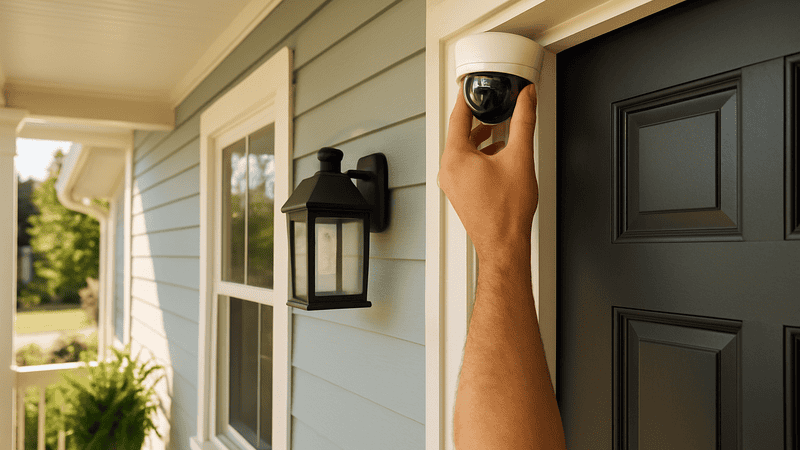
A visible camera’s entire value is in being seen. It broadcasts “this area is watched,” and for a large percentage of would-be thieves, porch pirates, and vandals, that’s enough to send them somewhere else. The deterrent effect is the product. That’s why dummy cameras for the front door work as well as they do — a convincing fake triggers the same avoidance response as a real one, at a fraction of the cost.
A hidden camera has the opposite job. It’s not there to scare anyone off. It’s there to record exactly what happens when someone believes no one is watching — which is precisely when the truth comes out. If you need proof of what an employee is doing, how a caregiver treats someone who can’t advocate for themselves, or who’s been in your house when you weren’t home, you need a camera that nobody knows exists.
Confusing these two purposes is where people get burned. They install a visible camera expecting it to catch an insider threat, and it doesn’t — because the person it needed to catch already knew where it was.
When does a visible camera actually make sense?
Visible cameras earn their keep at the perimeter — anywhere you want to stop a problem before it starts, not document it after the fact. Front doors, driveways, garages, and side entrances are the classic spots. A porch pirate deciding between two houses will skip the one with an obvious camera nine times out of ten.
The catch: not everyone can afford or wants a fully wired, monitored system for every angle of their property. That’s exactly where realistic decoys close the gap. A convincing dummy camera for the home mounted at eye level near an entry point does the same deterrent work as a real unit costing five times as much — because the person casing the house isn’t going to climb up and check if it’s wired. You want your perimeter to look watched. Whether it actually is, in every spot, is a separate decision.
The same logic applies to vehicles. Car break-ins are frequently crimes of opportunity — someone checking door handles down a row of parked cars. A visible unit like a dummy camera for the car mounted on the dash signals “this one’s not worth the risk” before anyone even tries the handle.
When do you actually need a hidden camera?
Ask yourself one question: do I need to prevent something, or do I need to know what’s happening when I’m not looking? If it’s the second one, a visible camera won’t get you there — the whole point is that the person of concern doesn’t know they’re being recorded.
This matters most in situations involving trust that’s already been compromised, or where the person you’re worried about has more access than you’d like. Hidden cameras for elderly care exist for exactly this reason — families need to know how an in-home aide actually behaves with a parent who may not be able to report a problem themselves. A camera disguised as a clock or air freshener records the real interaction, not a performance for the lens.
The workplace has the same blind spot. Cash handling, inventory shrinkage, harassment complaints that go nowhere without evidence — these all live in the space a visible camera can’t reach, because the person responsible adjusts their behavior the moment they know they’re on camera. Hidden cameras for the office are built to sit in plain sight without announcing themselves — disguised as everyday objects that nobody thinks twice about.
What are the risks of choosing the wrong type?
The biggest risk isn’t picking the “worse” option — it’s mismatching the tool to the threat. Put a visible camera where you needed a hidden one, and the person you were worried about simply avoids the frame. Put a hidden camera where you needed deterrence, and you’ll have great footage of a break-in that a visible unit might have prevented entirely.
There’s also a legal dimension you can’t skip over. Recording audio or video in private spaces — bathrooms, bedrooms, changing areas — carries real legal restrictions that vary by state and by relationship (employer-employee rules are different from parent-caregiver rules). Before placing any hidden camera, check your state’s consent laws and workplace regulations. This is a place where getting it wrong has consequences beyond a wasted purchase.
Battery life and storage are the other quiet risk. A hidden camera that dies after four hours or fills its memory card by lunchtime isn’t protecting anyone — it’s giving you a false sense of coverage. Know your unit’s actual runtime and storage capacity before you rely on it for anything that matters.
Can you use both hidden and visible cameras together?
Yes — and for most households and small businesses, that’s the setup that actually closes the gap. Visible cameras handle the perimeter and the obvious entry points, discouraging the casual opportunist before they try anything. Hidden cameras cover the situations where you need truth, not deterrence — inside the house, inside the office, anywhere trust is the actual issue.
Layering both means you’re not relying on one tool to do two different jobs. A front door camera in plain view plus a hidden unit watching the same entryway from a different angle gives you both the deterrent and the backup — if someone disables or covers the visible one, you still have footage of it happening.
Frequently Asked Questions About Hidden and Visible Cameras
Are hidden cameras legal to use in my home?
Generally yes for common areas of your own home, but recording in spaces with a reasonable expectation of privacy — bathrooms, bedrooms — is restricted almost everywhere. Rules also shift when a caregiver, nanny, or employee is involved. Check your specific state’s laws before installing any hidden camera involving another adult.
Do fake or dummy cameras actually deter crime?
Studies and law enforcement reports consistently show that visible deterrents — real or convincing decoys — reduce opportunistic crime because most offenders are looking for the path of least resistance and least risk. A realistic dummy camera changes that calculation the same way a real one does, for a much lower cost.
What’s the difference between a nanny cam and a hidden camera for elderly care?
Functionally, they’re often the same hardware — a disguised camera built into an everyday object. The difference is context: elderly care cameras are typically placed to monitor caregiver behavior and interactions rather than just activity, and families often prioritize longer battery life or continuous recording since care situations run all day.
How long do hidden camera batteries typically last?
It varies widely by model — some run 2-4 hours on battery alone, others last a full day when plugged in or paired with a power bank. If continuous coverage matters, look for a unit with AC power options or swap-and-charge battery packs rather than relying on a single charge.
Will a visible camera stop someone I already suspect is a problem?
Not reliably. Visible deterrents work on people weighing risk versus reward for opportunistic acts. Someone who already has ongoing access to you — an employee, a caregiver, a family member — will simply avoid the camera’s frame or alter behavior only when they know they’re watched. That’s exactly the scenario where a hidden camera gives you the accurate picture.
Can I use hidden cameras at work to monitor employees?
In many states, employers can monitor common work areas without consent, but there are limits — audio recording often requires different permissions than video, and areas like break rooms or restrooms are typically off-limits entirely. Check your state’s employment and surveillance laws before installing anything in a workplace.
What should I look for in a hidden camera besides how well it’s disguised?
Battery life, storage capacity or cloud backup, video resolution in low light, and whether it needs a live Wi-Fi connection or records to a card you retrieve later. A camera that looks perfect but records grainy footage or dies after two hours isn’t actually giving you coverage — it’s giving you false confidence.
Should I tell people a visible camera is there even if it’s fake?
You don’t have to announce it, but you don’t need to hide it either — the entire value of a visible or dummy camera is being seen. Mount it somewhere obvious, at a normal camera height, facing an entry point. The goal is for anyone considering trouble to notice it before they act, not to discover it later.
Every home and business has a blind spot somewhere — the question is whether you find it first, or someone else does. Whether that means a visible unit watching your front door, a disguised camera keeping an eye on your register, or a setup that pairs both, the right coverage starts with being honest about what you’re actually trying to catch. And if your safety plan extends beyond your doorstep, it’s worth reading how a personal alarm compares to pepper spray for the moments a camera can’t reach at all.