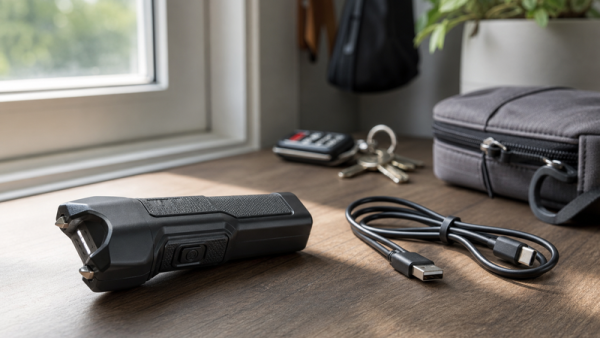
Mini stun guns can be just as powerful as full-size models — but size alone doesn’t tell the whole story. What actually determines stopping power is amperage, contact point spread, and build quality. A well-designed compact stun gun from a reputable brand will outperform a cheaply made full-size unit in real-world use. The right question isn’t how big it is. It’s how well it’s built.
That’s an answer most product pages won’t give you straight. There’s a temptation in this industry to let big numbers do the selling — “80 million volts!” printed in bold, with very little explanation of what that actually means when you’re holding a device the size of a lipstick tube. You deserve better than that. So let’s walk through exactly what’s happening inside these devices, what size actually affects, and how to make a confident choice for your situation.
What actually determines a stun gun’s stopping power?
Here’s something worth understanding before anything else: voltage is not the most important number on the spec sheet. It’s the one manufacturers love to advertise because big numbers look impressive. But in practice, voltage is what moves electricity through resistance — like air, clothing, or skin. Amperage is what actually disrupts muscle function.
Think of it like a garden hose. Voltage is the water pressure. Amperage is the actual volume of water coming through. You need both, but it’s the volume — the amperage — that does the work. Stun guns designed for self-defense typically operate in a range that’s effective for temporary incapacitation while remaining non-lethal. The difference between a good unit and a poor one is rarely about the voltage claim on the box.
Contact point spread matters too. The distance between the two prongs on the stun gun determines how deep the electrical charge can penetrate muscle tissue. Wider spread means more effective neuromuscular disruption. Some full-size stun guns have this advantage — but so do well-engineered compact models. It’s worth checking this spec when you’re comparing options.
Build quality is the third factor that doesn’t get enough attention. Internal components, the quality of the battery, and circuit reliability all affect whether a stun gun performs consistently when you need it to. A unit that delivers a strong shock on day one but degrades quickly — or fails in cold weather — isn’t actually protecting you. If you’re curious about what real stopping power looks like across different models, our post on how effective stun guns are for self-defense covers this in more depth.
Does a smaller stun gun really fit in your hand as well as a larger one?
Here’s something honest: for some people, a full-size stun gun feels more natural and is easier to grip under stress. If you have larger hands, a longer barrel gives you more surface area to hold onto. That’s not a knock on compact models — it’s just a real consideration.
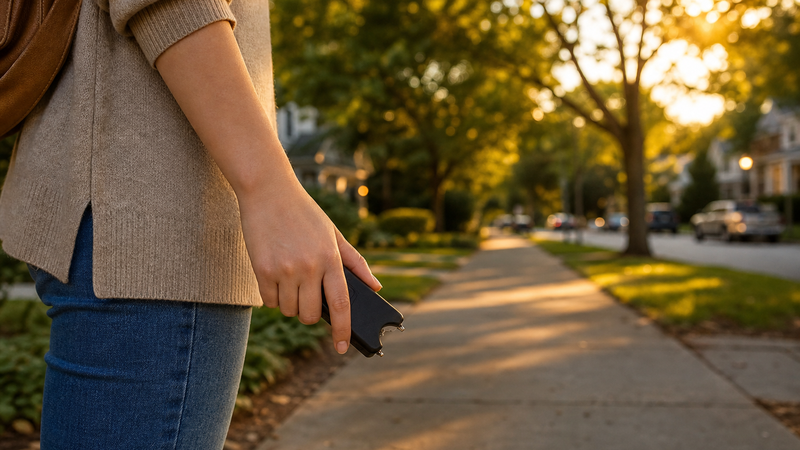
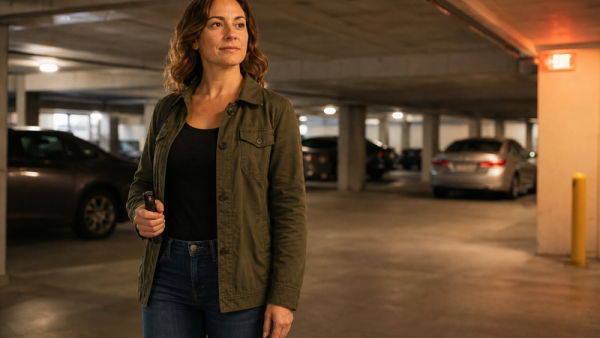
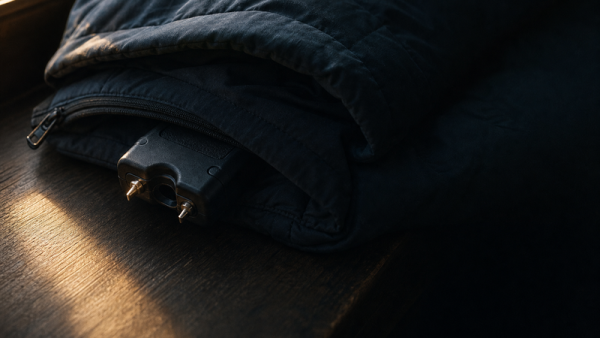
That said, fit matters less than carry. A full-size stun gun that stays home doesn’t protect you. A compact model on your keychain or in your jacket pocket does. The best self-defense tool is the one you actually have with you. This is especially true for people who are on the move throughout the day — professionals visiting unfamiliar properties, teachers working in unpredictable environments, or anyone who commutes alone.
Mini stun guns like the Runt are specifically engineered for a secure grip despite their small size. Rubberized coatings, contoured bodies, and built-in disable pins (wrist strap safety features that cut power if the device is grabbed from your hand) give compact models genuine functional advantages. A stun gun that gets knocked from your hand and used against you is worse than no stun gun at all. The disable pin solves that problem cleanly.
For people who want to carry consistently without adding bulk to their daily routine, a compact, affordable stun gun is often the more practical choice — and practical beats impressive on paper every time.
Are there situations where a full-size stun gun is genuinely the better choice?
Yes, and it’s worth being direct about this rather than pretending one size fits every situation. Full-size stun guns often have larger batteries, which translates to longer charge life and more consistent power output over time. If you’re looking for a unit that will be used more frequently — say, for a security professional or someone who is responsible for others’ safety — a larger model may hold up better over a sustained period of use.
Full-size models also tend to offer additional features: built-in flashlights, louder alarm functions, and in some cases, greater contact spread. The Streetwise and Stun Bat lines offer extended-reach options that make sense in specific contexts — vehicle security, home defense, or professional environments where a device needs to do more than one job.
If you’re equipping multiple people — say, a small team or household — a stun gun two-pack can make sense regardless of whether you go with compact or full-size models. Having two units available, stored separately, means you’re not caught without one when you need it most.
The honest takeaway: full-size stun guns are not more powerful by default. But they may be more appropriate depending on how you plan to use them, how often, and in what environment.
How do mini stun guns perform through heavy clothing?
This is a practical question that deserves a straight answer. Stun guns work by completing an electrical circuit through contact with the body. Clothing adds resistance — but it doesn’t stop a quality stun gun. What matters is probe spread (wider is better), amperage output, and whether you’re able to maintain firm contact during the activation period.
A mini stun gun with closely-spaced probes will struggle more against a heavy winter jacket than one with wider probe spread. This isn’t a size limitation exactly — it’s a design spec. Some compact stun guns are engineered specifically to address this, with probes positioned to maximize effectiveness through common clothing layers. Our post on whether stun guns work through clothing goes deeper into this if you want the full picture.
The practical advice: if you’re choosing a stun gun for winter carry in a cold climate, check the probe spread spec. Don’t just compare voltage numbers. A 25 million volt device with wide probe spread will outperform an 80 million volt device with narrow probes against a thick hoodie.
Is a mini stun gun a smart choice for specific professions or daily carry?
For the right person in the right context, a compact stun gun is not a compromise — it’s a deliberate and well-reasoned choice. Consider who actually needs to carry every day: professionals who move between locations, people who commute alone, teachers, real estate agents, and others who need something reliable, discreet, and ready without adding friction to their routine.
A real estate agent walking through an empty property alone doesn’t want to pull a full-size baton-style stun gun out of a bag. Something compact, immediately accessible, and easy to operate under stress is exactly right for that situation. We have a resource specifically for that context: a stun gun guide for real estate agents that walks through exactly what to look for.
Teachers, similarly, often need something they can carry in a pocket or keep within reach in a classroom setting — low profile, quick to access, effective if needed. A stun gun for teachers should fit those specific parameters. A compact model does this better than a full-size unit would.
The point isn’t that compact stun guns are universally better. It’s that for daily carry in professional or public settings, they solve a real problem: you’ll actually have it with you. And that’s what matters when seconds count.
How should you store and carry a mini stun gun to keep it ready?
Carrying a stun gun well is as important as choosing the right one. A few practical points that don’t get enough attention:
Keep it charged. Most rechargeable stun guns should be topped off every 1–3 months even if they haven’t been used. A stun gun with a dead battery is just plastic. If you’re comparing charging options, our post on rechargeable vs. battery-powered stun guns breaks down the tradeoffs honestly.
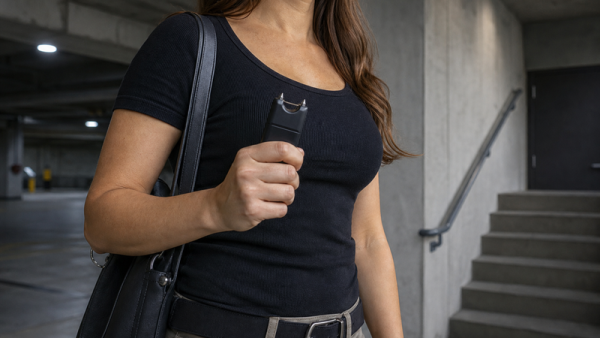
Keep it accessible, not buried. A stun gun at the bottom of a bag isn’t accessible in a real situation. Belt holsters, keychain clips, and purpose-built carrying solutions make the difference. If carrying on your body makes sense for your routine, a stun gun with a holster keeps it secure and immediately reachable without digging.
Know how it works before you need it. This sounds obvious, but a lot of people buy a stun gun and never actually test-fire it. Do a quick activation in a safe setting so you understand the mechanism, the sound, and what it feels like to operate under a little adrenaline. Familiarity matters under stress.
Check your local laws. Stun guns are legal in most U.S. states, but some have restrictions on voltage, carry methods, or specific locations. That’s on you to verify — local law is always the final word, and no product page should substitute for checking the rules where you live.
Frequently Asked Questions About Mini Stun Guns vs. Full-Size Models
Are mini stun guns less effective than full-size stun guns?
Not necessarily. Effectiveness depends on amperage output, probe spread, and build quality — not size. A well-designed mini stun gun from a quality brand will outperform a poorly built full-size model. Size affects grip, battery capacity, and feature set more than raw stopping power. Focus on specs and build quality, not the physical dimensions of the housing.
What voltage is enough for a mini stun gun to be effective?
Voltage specs in marketing materials are often inflated and difficult to verify. Rather than chasing the highest voltage number, focus on amperage output and probe spread — those are the factors that drive real-world effectiveness. Any quality stun gun from a reputable brand is engineered to be effective for self-defense. When in doubt, read independent reviews rather than manufacturer specs alone.
Can a mini stun gun work through clothing?
Yes, with some limitations. Probe spread matters here — wider-spaced probes penetrate clothing resistance more effectively. A compact stun gun with wide probe spread will work through light to moderate clothing layers. Very heavy outerwear (think thick winter coats) can reduce effectiveness with any stun gun. This is a design spec to check, not a size issue specifically.
Is a mini stun gun safe to carry in a purse or pocket?
Yes, if it has a safety mechanism — most quality compact stun guns do. Look for a physical safety switch or disable pin wrist strap that prevents accidental activation. Carrying an unsecured stun gun loose in a bag without a safety is not a good idea. Most reputable compact models are specifically designed for pocket or purse carry with appropriate safety features built in.
How long does the charge last on a mini stun gun?
Battery life varies by model. Most rechargeable compact stun guns hold a charge for several months of standby use. The recommendation for most models is to recharge every 1–3 months even without use to keep the battery conditioned. Some models use standard batteries instead — both approaches have tradeoffs worth considering based on how consistently you’ll maintain the device.
What makes a mini stun gun easy to use under stress?
Simple operation, secure grip, and familiarity. Compact stun guns with rubberized bodies, straightforward safety switches, and disable pins that prevent the device from being used against you are the key features to look for. Practice with the device before you need it — even a quick test activation in a safe setting builds the muscle memory that matters when adrenaline is running.
Are there situations where a full-size stun gun is a better choice than a mini model?
Yes. If you need longer battery life for frequent use, greater probe spread for a specific application, or additional features like a built-in flashlight or extended reach, a full-size model may serve you better. Security professionals, home defense applications, or anyone who prioritizes maximum feature set over portability may find full-size models more appropriate for their needs.
How do I know if a mini stun gun is legal where I live?
Stun guns are legal in most U.S. states, but some states and municipalities have restrictions on voltage ratings, carry methods, or specific locations. This is something you’ll need to verify with your state’s laws or local ordinances — not something a product page can answer definitively for you. When in doubt, check your state’s statutes or contact local law enforcement for clarification before purchasing.
The bottom line is straightforward: mini stun guns and full-size models are not separated by a meaningful power gap when both are quality-built. What separates them is carry comfort, battery capacity, feature set, and real-world accessibility. For most people carrying daily — especially those in professional roles or active routines — a compact, well-built stun gun is the right tool because it’s the one they’ll actually have with them.
Being prepared isn’t about having the most impressive-looking device. It’s about having the right one, understanding how it works, and carrying it consistently. That’s what real personal safety looks like — and it’s a choice you’re fully capable of making with the right information.