Both stun guns and pepper spray are legitimate, effective self-defense tools — but neither one is universally better. The right choice depends on where you live, how you carry, and what kind of situation you’re most likely to face. Pepper spray gives you distance; a stun gun gives you close-range stopping power. Most people find that one fits their life more naturally than the other, and that fit matters more than any spec sheet.
Here’s the honest truth: this question isn’t really about which tool wins in a head-to-head test. It’s about you — your daily routine, the environments you move through, the people you love who you want to get home to. When you frame it that way, the answer gets a lot clearer. Let’s talk through what each option actually does, where it shines, and where it falls short.
How does pepper spray actually work in a self-defense situation?
Pepper spray works by releasing a chemical compound — oleoresin capsicum, derived from hot peppers — that causes immediate, intense irritation to the eyes, nose, throat, and skin. When it hits, an attacker’s eyes clamp shut involuntarily. Their airway tightens. Their skin burns. None of that is something they can push through with willpower. It doesn’t matter how big they are or how much adrenaline they have — the body responds whether the brain wants it to or not.
What makes pepper spray feel so right for a lot of people is the distance it puts between you and a threat. A quality spray — something like Wildfire or Mace — can reach 10 to 12 feet. That means you can respond before someone closes the gap. You don’t have to wait until they’re within arm’s reach. For anyone who’s ever thought about what they’d actually do in a frightening moment, that distance feels like breathing room.
The tradeoff is real, though. Wind is not your friend. In an outdoor situation, a gust at the wrong moment can redirect the spray — or at least reduce its effectiveness. A tight indoor space can actually work in your favor, but most sprays produce some blowback that you’ll feel too. And if you’re wearing glasses or contacts, or the situation happens in the dark, hitting a moving target under stress is genuinely hard. These aren’t reasons to skip pepper spray — they’re reasons to train with it, carry it intentionally, and know your environment.
If you want a deeper look at the best options available, our guide on what is the best pepper spray for self-defense walks through the specifics without the marketing hype.
How does a stun gun work and what does it actually do to an attacker?
A stun gun delivers an electric shock on contact. You press the device against an attacker’s body, activate it, and the electricity temporarily disrupts their muscular and neurological function. Muscles lock up. Balance goes. It doesn’t knock someone unconscious — but it gives you several critical seconds to create distance and get away. That’s the whole point.
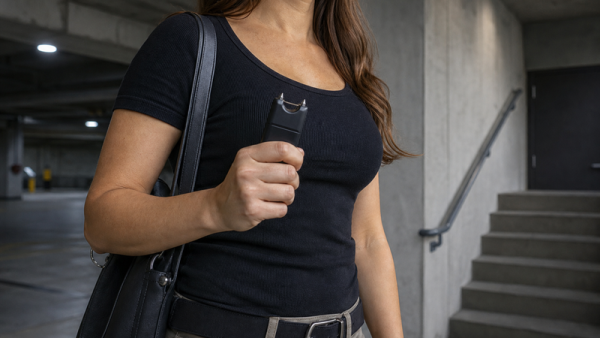
What a lot of people don’t realize is how much the form factor matters here. A stun gun you’ll actually carry is worth infinitely more than one you leave in your glove box. The stun gun with holster option exists exactly for this reason — so you can have it on your body, accessible, not buried in a bag. When things go sideways fast, you don’t have time to dig.
The critical thing to understand about stun guns is that contact is required. You have to be close — within arm’s reach — for it to work. For some people, that feels manageable; for others, it’s a dealbreaker. There’s no shame in either answer. But if the idea of being that close to a threat makes your stomach turn, that’s information worth listening to. Your instincts about what you can actually execute under pressure are worth more than any product comparison chart.
One underappreciated advantage: most stun guns won’t be affected by wind, rain, or blowback. They work the same in a parking garage as they do on a jogging trail. If you’re someone who moves through a lot of different environments, that consistency matters. For a look at how well they actually perform, our post on how effective stun guns are for self-defense gives you a grounded, honest answer.
Which is better for carrying every day without thinking about it?
This is where real life takes over from theory. The best self-defense tool is the one that’s actually with you — not the one that’s technically superior sitting at home on your nightstand.
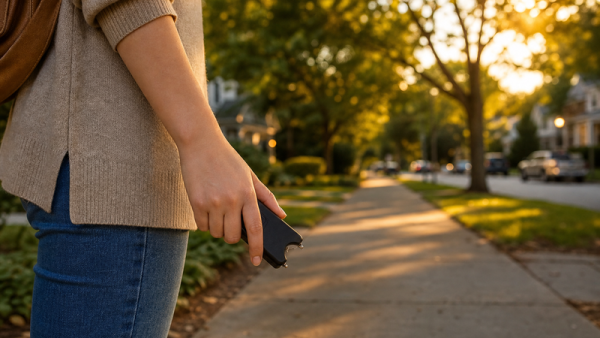
Pepper spray tends to win on everyday carry for a lot of people simply because it’s small, light, and easy to clip to a bag or keychain. You don’t have to think about it. It becomes part of what you grab before you walk out the door, like your keys and your phone. For busy people — teachers, parents, commuters — that friction-free carry matters enormously. If you’re a teacher looking at your options, the stun gun designed for teachers is worth a look alongside your pepper spray research, because the carry situation in a school environment is genuinely unique.
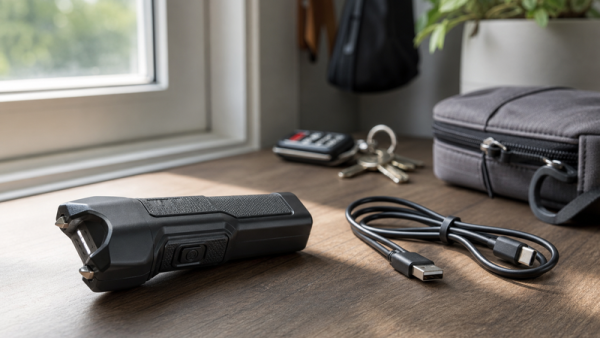
Stun guns have gotten significantly more portable over the years. The Runt and Shorty are small enough to fit in a palm. The SMART stun gun and MultiGuard models add features like personal alarms and flashlights — which means you’re carrying one tool that does several things. If you’re someone who prefers having a dedicated device rather than a canister attached to your keys, a compact stun gun can integrate into daily life just as naturally. The affordable stun gun options available today mean you don’t have to spend a lot to get something reliable.
Does it matter whether you’re indoors or outdoors?
It really does, and this is one of the most practical questions you can ask yourself before choosing.
Outdoors, pepper spray’s range is a genuine advantage — but wind vulnerability becomes a real consideration. If you live in a breezy climate or spend a lot of time outside, you’re working with a variable you can’t always control. A stun gun, by contrast, performs consistently regardless of weather. Rain, wind, humidity — none of it matters to an electrical charge.
Indoors, the equation shifts a little. In a tight space — a hallway, a stairwell, an apartment — the range advantage of pepper spray shrinks. And blowback in an enclosed area is more likely to affect you too. Stun guns shine in close-quarters situations precisely because contact is the whole mechanism. There’s no dispersal, no drift, no environmental variable. If your primary concern is home defense or navigating indoor spaces like parking structures, that’s worth weighting heavily in your decision.
Real estate agents face this exact dilemma — moving between empty homes, meeting strangers, navigating both indoor and outdoor environments every day. The stun gun built for real estate agents addresses that specific reality directly.
What if you want to share self-defense tools with someone you love?
One thing that doesn’t come up enough in these comparisons: you might not be the only one who needs to be protected.
A lot of people think about self-defense as a solo decision. But if you have a partner, a college student in the family, a sibling who lives alone — the conversation opens up. And when it does, the practical side of stun guns becomes even more appealing. The stun gun two-pack exists for exactly this reason: one for you, one for someone you care about. Same reliability, same simplicity, without doubling the research and shopping time.
Pepper spray is also shareable and easy to hand off — there’s no learning curve. But if you want two people equipped with tools that work the same way, respond the same way, and require the same minimal training, a two-pack is a practical and deeply human choice. Because protecting yourself and protecting the people you love are the same instinct.
If you’re looking specifically at how these tools compare for women’s safety scenarios, our post on pepper spray vs. stun gun for women covers that ground with the same honesty.
Frequently Asked Questions About Stun Guns vs. Pepper Spray
Can I carry both a stun gun and pepper spray at the same time?
Yes, and a lot of experienced carriers do exactly that. They’re not competing tools — they cover different distances and scenarios. Pepper spray handles threats at range; a stun gun handles close contact. Carrying both means you have more options in more situations. The added weight and bulk is minimal, and the added coverage is real. Just make sure you know your local laws on both before you commit.
Which one is easier to use under stress?
Both require practice, but pepper spray generally has a lower skill floor. You point and press. A stun gun requires physical contact, which means you have to close distance or hold your ground while the threat is close — that’s a harder mental and physical task under stress. Neither one works reliably without some familiarity. Carry whatever you choose often enough that reaching for it becomes muscle memory, not a conscious decision.
Do stun guns work through clothing?
Yes — a quality stun gun will penetrate standard clothing, including light jackets and hoodies. Very thick winter outerwear can reduce effectiveness, but a direct contact point on exposed skin or a thin layer makes it significantly more reliable. Some people target the neck, hip, or inner thigh in high-pressure situations because those areas tend to have less clothing barrier. That’s worth thinking through before you ever have to use it.
Can pepper spray be used indoors?
It can, but there are real tradeoffs. In an enclosed space, the spray disperses into the air around you too, which means you’ll likely feel some effects. Many formulas are designed to minimize blowback, and gel-based sprays reduce airborne drift significantly. If indoor defense is your primary concern, a stun gun may be the more comfortable choice — but pepper spray used in a hallway or stairwell can still be highly effective.
Is pepper spray or a stun gun better for someone who has never used self-defense tools before?
For a complete beginner, pepper spray tends to be more intuitive — it requires less physical proximity to use and has a simple trigger mechanism. That said, “better” really means “better for your specific situation.” A stun gun with a safety switch and a simple contact design isn’t complicated either. What matters most is familiarity. Whichever you choose, hold it, practice your draw, and know how it works before you rely on it.
Will pepper spray work on someone who is intoxicated or on drugs?
This is one of the most honest limitations of pepper spray: it can be less effective on someone who is extremely intoxicated, under the influence of certain stimulants, or experiencing a mental health crisis where their pain response is altered. It still causes physiological effects — the eyes still react — but the behavioral response may be slower or less predictable. A stun gun, which disrupts neuromuscular function rather than relying on pain compliance, may be more reliable in those specific scenarios.
How long does the effect of each tool last?
Pepper spray effects typically last 20 to 45 minutes — more than enough time to get away and get help. A stun gun’s incapacitation effect is shorter, usually 3 to 10 seconds of significant disruption, though disorientation can persist longer. Pepper spray’s longer window is one of its biggest practical advantages: you have more time to put distance between you and the threat before the effects wear off.
Are there places where one of these is restricted or illegal?
Both are legal in most U.S. states, but restrictions vary. Some states limit pepper spray canister size or concentration. Some cities restrict stun gun carry. A handful of states have more significant limitations on both. Always check the laws in your specific state and city before purchasing or carrying either tool — and if you travel, check the laws for your destination too. This is your responsibility to confirm, and it’s worth doing before you buy.
At the end of the day, this decision comes back to something simple: which tool fits your life well enough that you’ll actually have it with you? The one sitting unused is the one that can’t help you. Whether you land on pepper spray, a stun gun, or both, what matters most is that you’ve made a deliberate choice — one rooted in knowing yourself, your environment, and what you’re willing to do to protect the people and moments that mean everything to you. That kind of preparation isn’t fear. It’s love, made practical.