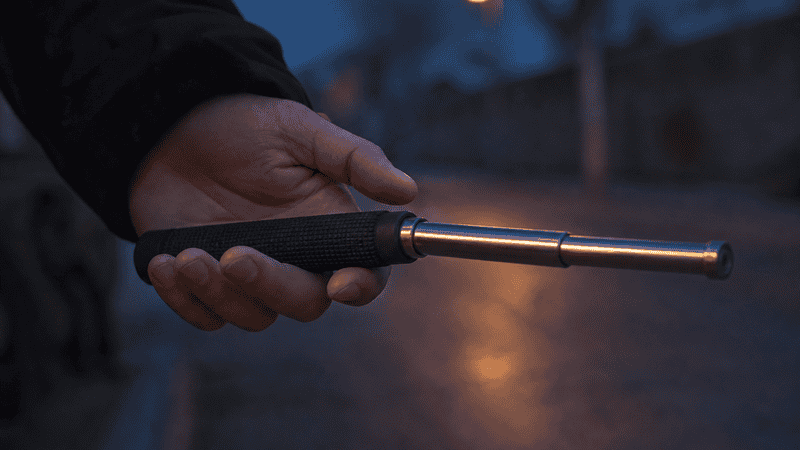
To extend a telescopic baton, hold it firmly in your dominant hand, point it downward at roughly a 45-degree angle, and snap your wrist sharply downward in a fast, controlled motion — the centrifugal force locks each segment into place. To retract it, press the tip firmly against a hard surface at a slight angle and apply steady downward pressure until all segments collapse back into the handle. That’s the core of it, but what most guides won’t tell you is that doing it wrong under pressure is more common than most people realize — and the difference between clean deployment and fumbling lies in details that take about ten minutes to understand and a week of practice to own.
What actually happens inside a telescopic baton when you flick it open?
There’s something almost mechanical and mysterious about the way a telescopic baton goes from a compact cylinder in your pocket to a full-length tool in under a second. Understanding what’s happening inside that motion changes how you train with it.
A telescopic baton — sometimes called an expandable baton or collapsible baton — is built from two or three nested steel or aluminum tubes, each slightly smaller than the last. When you snap your wrist downward, those segments travel outward along their nested path. The smallest segment at the tip travels the farthest. At the end of that travel, a friction lock or ball-bearing lock at the joint of each segment catches and holds under the outward tension created by the snap. The harder and faster the snap, the more reliably each lock seats.
What most people don’t realize is that a slow, tentative flick rarely locks all segments cleanly. You end up with a partially deployed baton — locked in an awkward middle position that serves no purpose. The snap has to be committed. That committed motion is what separates someone who’s practiced from someone who just owns one.
The direction matters too. Snapping straight downward is the most reliable deployment angle. Snapping outward to the side can work but introduces lateral force that sometimes causes the outer segment to lock before the inner ones are fully seated. Downward, 45 degrees, firm grip, fast snap. That’s the sequence.
Why do so many people struggle to retract a telescopic baton after it’s deployed?
This is the part that surprises people — and the part that almost no product description or YouTube thumbnail bothers to explain clearly. Retracting a telescopic baton is often harder than extending it, and if you’ve never practiced it, you’ll figure that out at the worst possible moment.
The same friction locks that hold the baton rigid when deployed resist being collapsed. They’re designed to hold under impact, so releasing them requires deliberate force applied in the right direction. The standard method is to locate a hard surface — concrete, asphalt, a wall — press the tip of the baton against it at a slight inward angle, and press downward firmly. The goal is to overcome the friction lock at the tip segment first, then the middle segment follows as the tip collapses back into it.
Some batons have a button-release or locking collar mechanism that assists retraction. If yours has one, know where it is before you need it. Know it by feel, in the dark, without looking. If yours is a pure friction-lock design, the surface-press method is your only option — and the surface you press against matters. Soft ground won’t give you the resistance you need. Hard, flat surfaces work best.
A word of practical honesty: the first few times you try to retract a baton after actually using it, the segments may be harder to collapse because impact can tighten the friction locks further. This is normal. Steady, controlled pressure — not panicked jabbing — is what gets it closed.
Does the grip you use when extending a telescopic baton affect how well it locks?
Yes, and this is one of those quiet details that most people discover by accident rather than instruction. Your grip during the snap determines how much energy transfers through the baton and how cleanly the segments seat.
Hold the handle in your full hand — not your fingertips. Your thumb should wrap around the handle, not rest along the spine. This gives you the most control over the snap and prevents the baton from rotating in your hand during deployment, which can cause uneven force on the locking segments.
Your wrist should be loose enough at the start of the motion to generate speed, then firm at the moment of snap. Think of it like cracking a whip — the loose start generates speed, the firm stop transfers it. A rigid arm throughout the motion reduces the snap speed and often results in a baton that only partially deploys.
The angle of your elbow also matters. Starting with your elbow slightly bent gives you a longer arc to accelerate through. Starting with your arm nearly straight shortens the motion and reduces the force available. Practice the full motion — elbow slightly bent, downward snap, firm wrist at the end — until it becomes automatic.
How do you know if your telescopic baton is locked and ready after extending it?
This is a question that has a surprisingly non-obvious answer. A locked baton should feel completely rigid — no play, no wobble, no give at the joints. If you shake it gently after deploying it and feel any movement at the segment joints, it’s not fully locked.
Run your free hand down the length quickly after extension. You’ll feel the joints immediately if any segment is slightly unseated. If you detect any looseness, the fastest fix is a firm secondary snap — point the tip downward again and give one more sharp flick. This usually seats any unsettled segment.
A partially locked baton is significantly weaker at the unsettled joint and can collapse inward under force. You want full rigidity before you rely on it for anything. This is exactly the kind of detail that only becomes clear through hands-on practice — which is why a lot of self-defense content you find online leaves you with an incomplete picture of what actually matters.
What’s the right way to practice extending and retracting a telescopic baton at home?
Here’s something most new owners never think about: the first time you deploy a telescopic baton under stress should not be the first time you’ve ever done it. The motion needs to be automatic before it becomes necessary.
Start slow. Practice the grip and the wrist snap motion without the baton first — just the motion itself, building muscle memory for the loose-to-firm transition. Then practice with the baton extended and already locked, working on the retraction against a firm surface until collapsing it takes less than three seconds consistently.
Then practice full cycles — extend, confirm lock, retract, repeat. Do this until you can complete a full cycle in under five seconds without thinking about it. That’s the threshold where the skill becomes genuinely useful rather than theoretical.
Practice in different conditions. Extend it with your non-dominant hand. Practice in a dark room. Practice with gloves on if you live somewhere cold. The goal isn’t to perform the motion perfectly under ideal conditions — it’s to perform it acceptably under conditions that are never ideal.
Also worth knowing: different batons have different snap characteristics. A heavier steel baton requires slightly more wrist speed. A lighter aluminum model may extend with less force but can feel less planted when locked. If you’re still exploring your options, browsing what fits your carry situation is worth time before committing to a specific model.
Are there situations where a telescopic baton isn’t the right tool to reach for?
The honest answer is yes, and it’s worth thinking through before you build your personal safety kit around one tool.
A telescopic baton is a contact-range tool. It requires you to be close enough to the threat to deploy it effectively — and it requires you to have already taken it out and locked it before you need it, or have the seconds and the clear-headedness to do it in the moment. In a sudden, zero-warning encounter, that window may not exist.
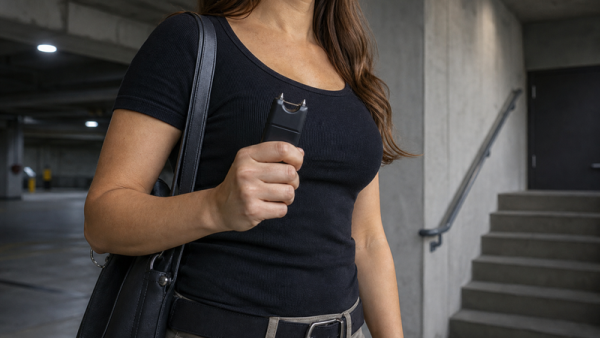
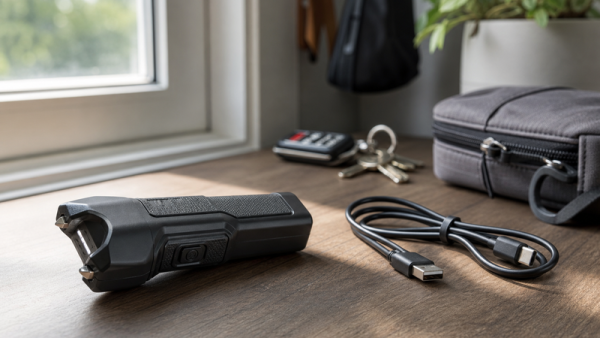
For situations where distance and reaction time are factors, a personal alarm gives you an immediate, passive deterrent that doesn’t require any deployment at all. For people who work in environments where they move between locations alone — like real estate agents — the calculus around tool selection gets even more specific, and it’s worth understanding what legal and practical considerations apply to your work setting before deciding what to carry.
A baton is a serious tool that deserves serious thought. It’s not wrong for a lot of people. But it works best as part of a layered approach to personal safety rather than a single answer.
Frequently Asked Questions About Extending and Retracting a Telescopic Baton
How hard do you have to snap a telescopic baton to lock it fully?
Harder than most people expect the first time. The snap needs to be fast and committed — a slow or tentative flick often leaves one or more segments partially seated. Think of it as a sharp, controlled downward snap rather than a casual swing. With practice, you’ll develop a feel for what “fully locked” sounds and feels like — a solid click and complete rigidity at the joints.
Can you retract a telescopic baton without a hard surface?
It’s difficult with a pure friction-lock design. The friction locks that hold the baton rigid under deployment also resist being collapsed by hand pressure alone. Most people don’t have the grip strength to overcome the locks without the mechanical advantage of pressing the tip against a hard surface. Some batons include a collar or button release that makes hand-retraction easier — check your specific model.
How long does it take to learn how to use a telescopic baton properly?
The basic deployment and retraction motion can be learned in one focused practice session of 20–30 minutes. Making it automatic — so the motion is reliable under stress — typically takes consistent daily practice over one to two weeks. Competence with any physical skill requires repetition under varied conditions, not just theoretical understanding.
Is it safe to practice extending a telescopic baton indoors?
Yes, with some precautions. Make sure you have enough clearance — a fully extended baton can be 16 to 26 inches depending on the model. Keep people and pets clear of your practice space. Practice over a carpeted surface in case the baton slips. And be aware that repeated deployment can cause surface wear on the tip — this is normal and doesn’t affect function.
Why won’t my telescopic baton lock when I snap it?
The most common cause is insufficient snap speed — the wrist motion is too slow to generate enough centrifugal force to seat the locking mechanism. Other causes include a worn friction lock, a bent segment from impact, or debris inside the barrel preventing full travel. Try a faster, more committed snap first. If that doesn’t resolve it, inspect the segments for visible damage or debris.
Is a telescopic baton legal to carry where I live?
Legality varies significantly by state and locality. Some states prohibit batons entirely; others allow them for all adults; some restrict carry to licensed security personnel. You’re responsible for knowing your local laws before purchasing or carrying one. When in doubt, check your state statutes directly or consult a local attorney — not a forum or a product description.
Does a heavier steel baton deploy differently than an aluminum one?
Yes. Steel batons are denser and require slightly more wrist speed to generate the force needed to seat all segments cleanly. They tend to feel more planted once locked. Aluminum batons are lighter and often easier to deploy quickly, but may feel less substantial when locked. Neither is universally better — the right choice depends on how you plan to carry and use it, and your own hand strength and wrist speed.
What should I do if my telescopic baton gets stuck in the open position?
Increase the force and change the angle of your retraction attempt. Press the tip against a harder surface — concrete is ideal — and apply steady, controlled downward pressure rather than quick jabs. If the baton was used to strike something hard, the impact may have tightened the friction lock beyond the normal retraction range. In that case, applying more deliberate pressure at a slightly different angle usually resolves it.
There’s a reason some tools earn quiet respect over time while others collect dust. A telescopic baton earns that respect when you understand what it actually takes to deploy it cleanly, confirm it’s locked, and close it when you’re done — not when you assume you’ll figure it out if the moment comes. The moment is a terrible teacher. Practice is a patient one.
If you’re building out a personal safety kit and want to see what’s available beyond the baton, explore the full range of non-lethal tools suited to your specific situation — because the right tool is always the one you’ve trained with and have with you.