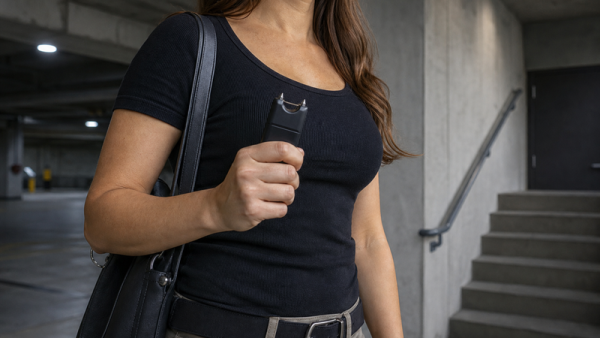
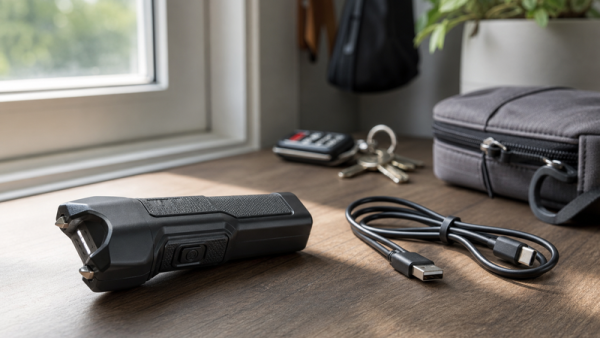
A stun gun and pepper spray are both non-lethal self-defense tools, but they stop a threat in completely different ways. A stun gun delivers an electrical charge that temporarily disrupts muscle control on contact, requiring you to be within arm’s reach. Pepper spray is a chemical irritant you spray from a distance — typically 6 to 12 feet — that causes intense burning and temporary vision loss. Neither is universally better. Which one belongs in your hand depends on factors most buyers never think to ask about.
Most people browse a few product pages, pick the one that looks right, and move on. But here’s what’s interesting: two people in nearly identical situations — same neighborhood, same commute, same level of concern about personal safety — often end up with completely different tools. And both of them are right. The real story isn’t which one is better. It’s understanding what each one actually does, what it demands of you, and what it can’t do. Once you see that clearly, the choice usually makes itself.
How does a stun gun actually work, and what does it feel like to be hit by one?
There’s a reason stun guns have a reputation that sometimes outpaces their reality — and a reason that reputation still points toward something true. A stun gun works by delivering a high-voltage, low-amperage electrical charge directly into the body on contact. That charge overrides the nervous system’s normal signals and causes involuntary muscle contractions. For a few critical seconds, the target loses control of their body. Disorientation, loss of balance, and pain follow. That window is what you use to get away.
What most buyers don’t realize is that voltage isn’t the whole story. A closer look at how stun gun voltage actually translates to stopping power reveals that amperage and contact time matter just as much. A higher-voltage device like the 100 million volt stun gun creates an intimidating arc and strong shock delivery — but any quality stun gun held firmly against the body for two to three seconds will produce a meaningful effect.
Here’s the part that surprises people: stun guns typically work through one layer of clothing. Not through a thick winter coat, but through a t-shirt or light jacket? Yes. That matters more than most product descriptions will tell you.
How does pepper spray work, and why does distance change everything?
Pepper spray operates on a completely different principle. The active ingredient — oleoresin capsicum, derived from hot peppers — causes an intense inflammatory reaction when it contacts the eyes, nose, and mouth. The eyes slam shut involuntarily. Breathing becomes labored. Burning on exposed skin is immediate and significant. The effect isn’t permanent, but it doesn’t need to be. It needs to buy you thirty seconds. That’s usually enough.
The distance advantage is real and shouldn’t be understated. Most pepper spray formulas reach 6 to 12 feet — some larger units further. That means a threat doesn’t have to reach you before you can respond. For many people, that gap is the deciding factor. You don’t have to wait until someone is close enough to touch you. You can act earlier, with more room to move.
What the distance doesn’t protect you from is wind, spray-back, and environmental variables. Outdoor use in a crosswind is a different calculation than using pepper spray in a hallway. Brands like Wildfire and Mace offer formulations specifically designed to minimize drift — a detail worth knowing before you buy. Indoors, a stream or gel formula generally performs more predictably than a cone or fogger pattern.
What are the real trade-offs between a stun gun and pepper spray that nobody talks about?
Here’s where it gets interesting — and where most comparisons stop short. Both tools have a shadow side that usually doesn’t make it into the product description.
With a stun gun, the requirement is contact. You have to be close. For some people, that’s not a limitation — it’s a feature. You know exactly where the charge is going. There’s no drift, no spray-back, no worry about affecting someone nearby. The stun gun with holster solves one of the tool’s less obvious challenges: keeping it accessible and ready without fumbling. A stun gun in the bottom of a bag that takes 15 seconds to retrieve is a stun gun that doesn’t help you.
With pepper spray, the trade-off is the opposite. Distance is an advantage — until it’s not. Gel formulas reduce drift but require more aim. Stream formulas travel farther but require a narrower target. And there’s the rare but real possibility that a highly agitated attacker continues through the initial spray. It usually doesn’t happen. But “usually” isn’t the same as “never.”
The other thing that doesn’t get discussed enough: whether a stun gun can be used more than once depends on the battery type and how it’s maintained. A rechargeable unit that’s been sitting uncharged for six months isn’t a reliable tool. Neither is a pepper spray canister that expired two years ago. Both require maintenance. Most people underestimate this.
Which one is easier to use under pressure, and does training matter?
This is the question that doesn’t get asked often enough — and it might be the most important one on this page.
Fine motor skills degrade under adrenaline. Buttons are harder to press. Safeties are harder to click off. Whatever you practice is what your hands will remember when it counts. A stun gun with a complicated safety mechanism and a small activation button is harder to deploy under stress than one with a large, intuitive trigger. A pepper spray canister that requires you to twist and unlock before spraying adds a step you might not complete cleanly.
This is why product design matters beyond specs. The stun gun two-pack is worth considering if you’re looking to keep one at home and carry one — familiarity with a single design means one less variable when your hands are shaking. For buyers with specific carry situations, like showing homes alone or working late in unfamiliar areas, the considerations get more specific. There’s a reason stun guns for real estate agents have become a niche of their own — the tool needs to fit the situation.
Neither pepper spray nor a stun gun requires formal training to use effectively. But both benefit from a few minutes of dry-run practice. Know where the safety is. Know how to activate it under a jacket, in the dark, with one hand. That’s not paranoia. That’s just being honest about how stress affects the body.
Are there situations where one is clearly the better choice?
There are patterns worth paying attention to. Neither tool is universally superior, but certain situations favor one over the other in ways that become clearer once you look at them directly.
Pepper spray tends to make more sense if you spend time outdoors — running, walking a dog, moving through open spaces — where distance is available and you want the option to act before someone is within arm’s reach. It’s also the choice many people make when they want something lightweight that disappears into a pocket or clips to a running belt without thought.
A stun gun tends to make more sense in environments where distance isn’t available — parking garages, elevators, stairwells — or where wind and spray-back are legitimate concerns. For anyone who has worried about accidentally affecting a bystander, the contact requirement of a stun gun eliminates that variable. It goes exactly where you aim it.
Some people carry both, and that’s not an unreasonable conclusion. A small pepper spray for outdoor distance threats, and a compact stun gun for close-quarters situations. Understanding the difference well enough to choose one is a good starting point. Understanding both well enough to carry both intentionally is the next level.
For a deeper look at this question from a specific angle, this breakdown of pepper spray vs. stun gun for women covers some of the situational differences worth thinking through.
Frequently Asked Questions About Stun Guns vs. Pepper Spray
Can pepper spray affect me if I use it near someone else?
Yes, it’s possible — especially with cone or fogger spray patterns in enclosed spaces. Gel and stream formulas reduce this risk significantly. If you’re concerned about affecting bystanders, a stun gun’s contact requirement eliminates that variable entirely, since the charge only goes where the device physically touches.
Will a stun gun work through clothing?
Yes, in most cases. A stun gun will generally work through a light jacket or single layer of clothing. Very thick materials — heavy winter coats, padded jackets — can reduce effectiveness. For maximum contact, aim for the neck, underarm, or thigh where fabric tends to be thinner or pulled tighter against the body.
How long do the effects of pepper spray last?
Typically 30 to 45 minutes, though intensity peaks in the first few minutes and gradually decreases. Eyes usually recover more slowly than skin. The goal isn’t a lasting effect — it’s a window of time to create distance and get help. That window is usually more than enough when used correctly.
Does a stun gun work on someone who is intoxicated or on drugs?
This is a legitimate concern. Alcohol and some substances can reduce the felt pain response, though the neuromuscular disruption still occurs to varying degrees. No non-lethal tool guarantees effectiveness in every situation. This is one reason why understanding your environment and creating distance whenever possible matters as much as the tool itself.
Is pepper spray legal everywhere?
Pepper spray is legal in all 50 states, but some states restrict the size of the canister, the concentration of the formula, or who can carry it. Restrictions exist in certain cities and locations regardless of state law. Check your local regulations before purchasing — this is your responsibility, not something to assume about.
Are stun guns legal in every state?
No. Stun guns are restricted or prohibited in certain states and localities. Hawaii, Rhode Island, and a handful of other jurisdictions have specific restrictions, and local ordinances can add another layer. Before you buy, look up the current laws for your state and city. Laws also change, so it’s worth checking periodically even if you’ve confirmed this before.
Which is harder to use in the dark or under stress?
Both have the same challenge: fine motor skills degrade under adrenaline. Stun guns with large activation buttons and simple safeties tend to perform better under stress. Pepper spray with a flip-top safety is generally easier to operate than a twist-lock design. Practice the draw and activation of whichever tool you carry — that familiarity is what carries over when your hands are shaking.
Can I carry both a stun gun and pepper spray?
Yes, and many people do. They address different threat distances and environments. A compact pepper spray handles outdoor scenarios where distance is available; a stun gun handles close-quarters situations where spray-back is a concern. The only caveat: carrying two tools you haven’t practiced with is less useful than carrying one you know cold.
The difference between a stun gun and pepper spray isn’t really about which one is more powerful or more intimidating. It’s about how each one works, what it asks of you, and which one fits the situations you actually find yourself in. Both are proven tools. Both have specific strengths and specific limits. The one that’s right for you is the one you’ll actually carry, actually maintain, and actually be able to use when it counts.
Browse the options at Revere Security — from budget-friendly stun guns to full-featured models — and take your time with the decision. A choice made carefully is worth more than one made quickly.