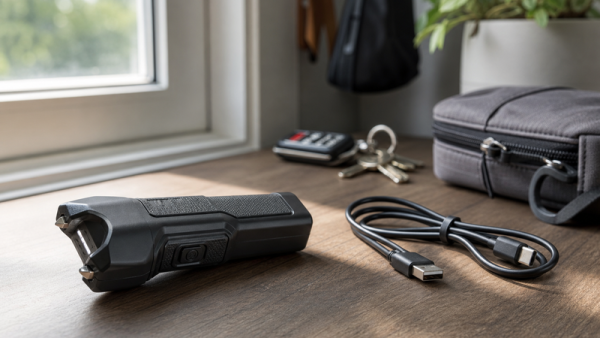
Standard pepper spray works on dogs, but not the way most people assume. A dog’s biology changes what “works” means — nasal passages built for scent, not obstruction, and a pain threshold that shifts entirely under adrenaline. The sprays that actually stop a charging dog are foggers and high-volume streams with wide-area coverage, not the tight self-defense streams marketed for human attackers. Get the formula, the pattern, and the timing wrong, and you may end up with an angrier dog and an empty canister.
What Most People Never Ask About Dog Attacks
There’s a question almost nobody asks before they need the answer: does pepper spray actually work on a dog the same way it works on a person? The assumption is that if it stops a human attacker, it’ll stop anything with a pulse. That assumption is wrong more often than the internet lets on.
A dog’s respiratory system isn’t built like ours. Their nasal passages are longer, more convoluted, and lined with a scent-processing structure humans don’t have. That means the capsaicin in pepper spray reaches different tissue, in different concentrations, with different results. Some dogs go down fast. Others, especially ones already in a state of aggression or fear, seem to barely register it for the first several seconds — seconds that matter enormously when you’re the one being charged.
This is the part nobody tells you at the counter when you’re buying a canister for your morning walk. The formula matters. The delivery pattern matters. And the moment you deploy it matters more than almost anything else in the encounter.
Does Pepper Spray Actually Stop a Dog Attack?
Yes — but only under specific conditions that most carriers never learn until it’s too late to matter. A concentrated OC (oleoresin capsicum) spray causes the same involuntary reaction in canines that it does in humans: intense burning of the mucous membranes, temporary blindness, and a coughing or gagging reflex that interrupts aggression. The mechanism works. The delivery is where things fall apart.
A tight defensive stream — the kind designed for a human attacker at seven feet — is built for accuracy against a face that isn’t moving fast in three dimensions. A dog is. A charging dog is low, fast, and often erratic in its approach, weaving as it closes distance. A narrow stream that misses does nothing except announce that you’re now out of time and out of options.
This is why serious trainers and wildlife professionals favor fog patterns and high-volume cone sprays for animal encounters — the same reasoning behind why bear spray uses a wide fogging cloud instead of a stream. You’re not trying to hit an eye. You’re trying to fill the air in front of you so the animal runs through it no matter which way it dodges.
What’s the Difference Between Regular Pepper Spray and Dog-Specific Spray?
The difference isn’t always the formula — it’s the pattern and the volume. Some products marketed specifically for animal encounters use the same OC concentration as personal defense sprays but deliver it in a fogging pattern with a larger canister capacity, because a single half-second burst rarely does the job on an animal already committed to an attack.
There’s something else buried in the fine print that most buyers skip past entirely: dog-specific sprays often include a slightly different capsaicin ratio, tuned for canine sensitivity rather than human. It’s a small distinction with an outsized effect. What burns a person into retreat and what actually interrupts a dog’s bite reflex aren’t identical thresholds.
If you’re deciding between a compact keychain unit and something larger, this is where the decision actually gets made. A belt clip pepper spray with a higher-volume canister gives you more product to work with if the first burst doesn’t fully connect — and against a moving target, it usually doesn’t on the first try.
How Close Do You Need to Be for Pepper Spray to Work on a Dog?
Closer than you’d like, and that’s the uncomfortable truth most product descriptions leave out. Most sprays are rated for six to twelve feet of effective range, but a dog covers that distance in under a second and a half at a dead run. The real answer isn’t a number — it’s a principle: deploy early, deploy wide, and don’t wait for point-blank certainty.
The mistake carriers make is treating pepper spray like a last-resort trigger, something reserved for the moment contact is unavoidable. With a charging dog, that moment arrives too fast to react to. The spray needs to be already in your hand, already aimed low toward the dog’s approach path, before the animal is within your effective range — not after.
This is a different mental model than the one built for human threats, where distance and warning time tend to be more forgiving. Dogs close ground the way almost nothing else does, and that changes everything about when you commit to deploying.
What Should You Actually Carry for Dog Encounters?
Something with volume, a wide dispersal pattern, and enough product to survive more than one burst. A single half-second self-defense-sized canister built for a mugger encounter is the wrong tool here — not because the chemical is wrong, but because the container runs dry exactly when you need it most.
People who walk regularly through areas with loose dogs — rural mail carriers, delivery drivers, runners on unfamiliar routes — tend to gravitate toward larger-capacity sprays for exactly this reason. It’s the same logic behind why security professionals carry higher-volume units rather than the smallest canister available: more encounters, more uncertainty, more need for margin.
If you’re building a setup around a dog-prone route — a rural walk, a delivery job, an early run before the neighborhood’s awake — pair that spray with something that keeps your hands free and your reaction time fast, since fumbling for a canister buried in a bag defeats the entire purpose of carrying one at all.
What Mistakes Make Pepper Spray Fail Against a Dog?
Three mistakes account for almost every failed deployment reported. The first is wind — spraying into or across a crosswind sends the fog back toward you instead of the dog, and outdoors, wind is rarely absent. The second is distance miscalculation, deploying too early into empty air or too late into a dog already at your leg. The third, and the most common, is hesitation — waiting for absolute certainty of attack before reaching for the canister, which erases the seconds you needed to aim.
There’s a fourth failure that’s less about technique and more about neglect: expired product. OC sprays lose pressure and potency over time, and a canister that’s been sitting in a glove compartment for three years may deliver a fraction of its rated output. If you haven’t checked, it’s worth understanding what expiration actually does to your spray’s effectiveness before you’re relying on it in a driveway at dusk.
What separates the people who walk away from a dog encounter unscathed from the ones who don’t usually isn’t luck. It’s whether the canister was accessible, current, and aimed with the right pattern before the dog closed the gap.
Frequently Asked Questions About Pepper Spray for Dog Attacks
Will pepper spray permanently hurt a dog?
No. Properly formulated OC spray causes temporary irritation to the eyes, nose, and throat that resolves within twenty to forty-five minutes, similar to its effect on humans. It’s designed to interrupt aggression, not cause lasting harm. Flushing the animal’s eyes with clean water afterward speeds recovery.
Can I use human pepper spray on a dog, or do I need a special formula?
Standard OC pepper spray will affect a dog, but formulas and canisters built with wider dispersal patterns and larger volumes tend to perform more reliably against a moving animal than a narrow defensive stream designed for a stationary human target.
How far away should a dog be before I spray it?
Don’t wait for a specific distance — deploy as soon as aggressive charging begins, aiming low and slightly ahead of the dog’s path. Most dogs close six to twelve feet of ground in well under two seconds, faster than most people can react to a point-blank threshold.
Does pepper spray work on all dog breeds equally?
Reaction speed varies by individual animal, adrenaline state, and breed sensitivity, but the biological mechanism — irritation of mucous membranes — applies across all dogs. Larger, more determined breeds may take a second or two longer to disengage than smaller ones.
What if the wind blows the spray back at me?
This is one of the most common deployment failures outdoors. Whenever possible, position yourself with the wind at your back before spraying, and favor a wider fog pattern over a narrow stream, since fog patterns are somewhat more forgiving of crosswind drift than a tight jet.
Is pepper spray legal to use on someone else’s dog?
Laws vary by location and generally hinge on whether you reasonably believed you were in danger of an attack. This isn’t something to guess at in the moment — check your local regulations ahead of time so you’re not making that determination for the first time under stress.
How is dog pepper spray different from bear spray?
Both rely on wide fog patterns rather than narrow streams, but bear spray is formulated with higher volume and range to affect a much larger animal from a safer distance. Dog encounters typically happen at closer range, so a compact high-volume canister is usually more practical to carry daily.
Should I carry pepper spray even if I don’t expect to encounter aggressive dogs?
Most people who end up needing it didn’t expect the encounter either. If you already carry spray for personal safety — walking, running, or working alone — knowing how it performs differently against an animal than a person means you’re not discovering the gap in a moment that doesn’t allow for learning curves.
The Part Most Carriers Never Learn Until It’s Too Late
There’s a reason this topic doesn’t get covered the way basic self-defense does. Most guidance assumes a human attacker, a stationary target, a narrow stream. Dogs break every one of those assumptions, and the gap between what people think they’re carrying and what they actually need only becomes visible in the moment it matters most.
The carriers who never have a problem are usually the ones who asked these questions before they needed the answer — who understood pattern over precision, volume over minimalism, and timing over hesitation. That’s not a complicated shift. It’s just one most people never make until something forces the issue. Understanding how to deploy pepper spray correctly changes everything about whether that canister on your keychain is a real answer or just a false sense of one.