Rechargeable Stun Guns: Complete Guide to Choosing and Maintaining Your Device
Quick Answer
Rechargeable stun guns eliminate the need for battery replacements by featuring built-in rechargeable power systems, available in both USB and wall-plug configurations. They offer significant cost savings over time, with users saving approximately $50-100 over three years compared to battery-operated models. The average rechargeable stun gun holds a charge for 3-6 months and lasts 500-1,000 charge cycles before battery replacement is needed. Key advantages include consistent power output, environmental benefits, and always-ready reliability. When choosing a rechargeable model, prioritize voltage appropriate for your needs (10-30 million volts), charging convenience (USB models offer maximum flexibility), and additional features like built-in flashlights or safety switches. Monthly charging maintains optimal battery health even when not in use.
When you reach for a self-defense device in a critical moment, the last thing you want to discover is dead batteries. This common scenario has led thousands of people to switch from traditional battery-operated stun guns to rechargeable models that are always ready when needed.
Rechargeable stun guns have revolutionized personal safety by combining powerful protection with modern convenience. No more scrambling to find replacement batteries at 2 AM or worrying whether your device will work when it matters most.
In this comprehensive guide, you’ll discover everything you need to know about rechargeable stun guns, including how they work, their advantages over traditional models, how to choose the right one, and proper maintenance techniques to ensure your device remains reliable for years to come.
What Are Rechargeable Stun Guns and How Do They Work
Rechargeable stun guns are self-defense devices powered by internal rechargeable batteries rather than replaceable batteries. These devices deliver high-voltage electrical charges to temporarily incapacitate an attacker while offering the convenience of simple recharging when power runs low.
The technology behind rechargeable stun guns centers on lithium-ion or nickel-metal hydride (NiMH) batteries built directly into the device. These batteries store electrical energy that’s released through the stun gun’s electrodes when activated, delivering the same stopping power as battery-operated models.
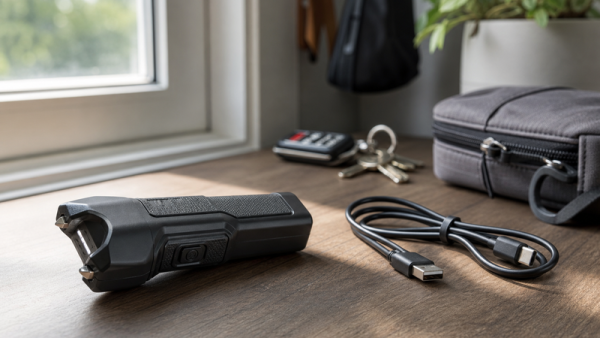
Modern rechargeable stun guns come in two primary charging configurations. USB rechargeable models feature a charging port that accepts standard USB cables, allowing you to charge from computers, wall adapters, car chargers, or portable power banks. Wall rechargeable models have a built-in or fold-out plug that connects directly to standard electrical outlets.
The charging process typically takes 4-8 hours for a full charge, though some newer models feature quick-charge capabilities that reduce this time. LED indicators on most devices show charging status, changing color when the battery reaches full capacity.
When fully charged, a quality rechargeable stun gun can hold its charge for 3-6 months without use. During active use, most models deliver 50-100 charges before requiring a recharge, depending on the duration of each activation.
Key Advantages of Rechargeable Over Battery-Operated Models
The benefits of rechargeable stun guns extend far beyond simple convenience. Understanding these advantages helps you make an informed decision about which power system best meets your self-defense needs.
Cost Savings Over Time
While rechargeable stun guns typically cost $5-15 more upfront than battery-operated models, they quickly pay for themselves. Battery-operated stun guns require new batteries every 3-6 months even with minimal use, costing approximately $4-8 per replacement.
Over a three-year period, you’ll spend $50-100 on replacement batteries for a traditional model. A rechargeable unit eliminates this recurring expense entirely, requiring only occasional electricity for charging, which costs mere pennies per year.
Time Period
Battery-Operated Cost
Rechargeable Cost
Savings
Year 1
$20 (initial) + $16 (batteries)
$30 (initial)
$6
Year 3
$20 + $48 (batteries)
$30
$38
Year 5
$20 + $80 (batteries)
$30
$70
The longer you own a rechargeable stun gun, the greater your savings become. This makes rechargeable models the clear winner for long-term value.
Environmental Benefits
Disposable batteries create significant environmental waste. Americans discard approximately 3 billion batteries annually, with many ending up in landfills where they leak toxic chemicals into soil and groundwater.
A single rechargeable stun gun eliminates the need for 20-30 disposable batteries over its lifetime. This reduction in battery waste contributes to environmental conservation while reducing your carbon footprint.
Consistent Power and Reliability
Disposable batteries gradually lose voltage as they deplete, causing stun gun power to weaken over time. You might not realize your device is running low until it fails to deliver adequate charge in a critical situation.
Rechargeable stun guns maintain consistent voltage output until the battery nears complete depletion. Most models include visual battery indicators that clearly show remaining charge, eliminating guesswork about device readiness.
This consistency ensures your stun gun delivers full stopping power every time you need it, provided you maintain regular charging habits.
Always Ready Convenience
Rechargeable stun guns offer unmatched convenience for modern users. You can charge them anywhere you have access to USB power, including in your car during commutes, at your office desk, or using a portable power bank.
This flexibility means you never need to keep spare batteries on hand or make emergency store runs. Simply plug in your device monthly, and it remains ready for use whenever needed.
Types of Rechargeable Stun Guns Available
Rechargeable stun guns come in various configurations, each designed to meet different user needs and preferences. Understanding these options helps you select the model that best fits your lifestyle and self-defense requirements.
USB Rechargeable Stun Guns
USB rechargeable models feature a charging port that accepts standard micro-USB or USB-C cables. This design offers maximum charging flexibility since USB power sources are nearly universal in modern life.
Key advantages include the ability to charge from laptops, car USB ports, wall adapters, and portable power banks. You can even charge your stun gun at work without anyone knowing, as the process looks identical to charging a phone.
USB models typically include a charging cable in the package, though you can use any compatible USB cable. The charging port usually features a protective rubber cover to prevent dust and moisture entry when not in use.
Wall Plug Rechargeable Stun Guns
Wall rechargeable stun guns feature built-in prongs that fold out or slide down for direct connection to electrical outlets. This traditional design eliminates the need for cables and ensures you can always charge at home.
These models appeal to users who prefer simplicity and don’t need the portability of USB charging. The built-in plug means you’ll never lose or misplace a charging cable, reducing potential frustration.
Some wall rechargeable models feature flip-out prongs that fold flat when not in use, maintaining a compact profile for carrying. Others have fixed prongs protected by a removable cover.
Rechargeable Stun Guns by Form Factor
Beyond charging method, rechargeable stun guns come in multiple form factors, each with specific advantages:
Flashlight rechargeable stun guns: Combine powerful illumination with self-defense capability, perfect for walking at night or investigating suspicious sounds. The flashlight provides a legitimate reason to carry the device while offering 200+ lumens of brightness.
Mini and compact rechargeable models: Measure 4-5 inches in length and easily fit in pockets or small purses. Despite their size, modern compact rechargeable stun guns deliver 15-25 million volts, providing serious stopping power in a discreet package.
Tactical rechargeable stun guns: Feature professional-grade construction with rubberized grips, extra safety features, and durable housings designed for law enforcement and security professionals. These models prioritize reliability and longevity.
Keychain rechargeable stun guns: Attach directly to your keys for ultimate accessibility. Their small size (typically 3-4 inches) makes them highly concealable while delivering adequate voltage for self-defense situations.
Each form factor is available with either USB or wall charging, allowing you to select both your preferred shape and charging method independently.
Selecting the ideal rechargeable stun gun requires evaluating several key factors that affect both performance and usability. Consider these elements to find a device that meets your specific needs.
Voltage Requirements and Effectiveness
Stun gun voltage typically ranges from 1 million to 30 million volts, but voltage alone doesn’t determine effectiveness. Amperage (current flow) matters more for incapacitation, though manufacturers rarely advertise this specification.
For practical self-defense purposes, any rechargeable stun gun delivering 10+ million volts provides adequate stopping power. Higher voltages offer psychological advantages through louder crackling sounds and brighter arcs, which may deter attackers without physical contact.
Voltage Range
Best For
Typical Effects
10-15 Million
Budget-conscious buyers
Pain compliance, momentary disorientation
15-25 Million
Most users
Muscle disruption, loss of balance
25-30+ Million
Maximum deterrence
Temporary incapacitation, confusion
Remember that all stun guns work through pain compliance and muscle disruption. No consumer stun gun will instantly render an attacker unconscious as depicted in movies.
Battery Life and Charging Considerations
Evaluate how long a rechargeable stun gun holds its charge and how quickly it recharges. Quality models maintain charge for 3-6 months between uses, while budget options may need monthly charging even without use.
Charging time varies from 4-12 hours depending on battery capacity and charging system. Fast-charging models complete in 4-6 hours, while standard models require 8-10 hours for full charge.
Look for clear battery indicators, preferably LED lights that show charging status and remaining battery life. Some advanced models feature percentage displays or multi-color indicators that provide precise charge information.
Size, Weight, and Portability
The best rechargeable stun gun is one you’ll actually carry consistently. Consider how and where you plan to carry your device daily.
Compact models (4-6 inches, 3-5 ounces) easily fit in pockets or small purses but may be harder to grip firmly. Full-size models (6-9 inches, 6-10 ounces) provide better grip control and often include additional features but require dedicated carrying space.
Test the grip if possible before purchasing. Your hand should comfortably wrap around the device with your thumb able to reach the activation button naturally. Rubberized grips prevent slipping during high-stress situations.
Essential Safety Features
Modern rechargeable stun guns include multiple safety features to prevent accidental discharge. Prioritize models with at least two safety mechanisms.
Safety switches: Physical switches that must be in the “on” position before the stun gun activates, preventing accidental discharge when jostled in a bag or pocket.
Disable pins: Wrist strap attachments that must remain connected for the device to function. If an attacker takes your stun gun, pulling the strap disables the device immediately.
Trigger guards: Recessed or covered buttons that require deliberate pressure to activate, reducing accidental activation risk.
LED battery indicators: Show remaining charge so you never carry a depleted device unknowingly.
Additional beneficial features include built-in alarms that sound when activated, flashlights for illumination and disorientation, and lifetime warranties that demonstrate manufacturer confidence in product durability.
Budget Considerations and Value
Rechargeable stun guns range from $15 to $70, with most quality options falling in the $25-45 range. Budget models under $20 often use inferior batteries that hold charge poorly and fail within a year.
Mid-range models ($25-45) typically offer the best value, featuring reliable rechargeable batteries, adequate voltage, and essential safety features. Premium models ($50+) add features like tactical construction, advanced electronics, and extended warranties.
Consider total cost of ownership rather than just purchase price. A $30 rechargeable stun gun with a lifetime warranty costs less over five years than a $20 model you replace twice during that period.
Charging and Maintenance Best Practices
Proper charging and maintenance extend your rechargeable stun gun’s lifespan while ensuring it functions reliably when needed. Follow these best practices to maximize your device’s performance and longevity.
Initial Charging and Setup
When you receive a new rechargeable stun gun, fully charge it before first use even if it arrived partially charged. This initial full charge conditions the battery and establishes optimal performance from the start.
For USB models, connect the charging cable to the port and plug into a power source. Wall models simply fold out the prongs and insert directly into an outlet. Most devices show a red light while charging that turns green when complete.
Avoid using your stun gun during this first charge. Allow the full 4-8 hours for complete charging, which establishes the battery’s capacity baseline for future charges.
Establishing a Charging Schedule
The key to rechargeable stun gun longevity is maintaining a regular charging schedule rather than waiting for complete depletion. Lithium-ion and NiMH batteries last longest when kept between 20-80% charge.
Test and charge your stun gun monthly, even if you haven’t used it. This practice ensures the device remains ready while preventing the battery from sitting in a depleted state, which degrades capacity over time.
Usage Pattern
Recommended Schedule
Reason
Daily Carry
Monthly test + charge
Maintains readiness despite gradual discharge
Occasional Use
Every 2-3 months
Prevents deep discharge damage
After Actual Use
Immediately
Ensures device ready for next need
Storage
Every 4-6 months
Maintains battery health during non-use periods
Set a monthly reminder on your phone to test and charge your stun gun. This simple habit prevents surprises and extends battery life significantly.
Proper Charging Techniques
Always use the charging cable or method provided with your stun gun. While most USB models work with any USB cable, some require specific amperage that generic cables may not provide, leading to slow or incomplete charging.
Charge in a cool, dry location away from direct sunlight or heat sources. Excessive heat during charging degrades battery capacity faster and can pose safety risks.
Avoid leaving your stun gun plugged in continuously for days or weeks. While most models include overcharge protection, unnecessarily long charging periods stress the battery. Unplug when the indicator shows full charge.
Never attempt to use your stun gun while it’s charging. This practice can damage internal circuitry and may void your warranty.
Long-Term Storage Guidelines
If storing your rechargeable stun gun for extended periods, charge it to approximately 50-70% capacity before storage. Storing at full charge or empty causes faster capacity degradation.
Store in a cool, dry place away from temperature extremes. Ideal storage temperature ranges from 50-70°F. Avoid garages, attics, or vehicles where temperature fluctuations occur.
Check and recharge stored stun guns every 4-6 months. Even when not in use, rechargeable batteries slowly self-discharge. This maintenance charge prevents deep discharge that permanently reduces capacity.
Recognizing When Battery Replacement Is Needed
Rechargeable stun gun batteries typically last 500-1,000 charge cycles, translating to 3-7 years depending on usage patterns. Several signs indicate declining battery health:
Shorter charge retention: Device requires charging more frequently than when new, holding charge for only 1-2 months instead of 3-6 months.
Extended charging time: Takes significantly longer to reach full charge than originally specified.
Weaker performance: Electrical arc appears smaller or sounds quieter than when device was new.
Rapid discharge: Battery indicator drops quickly from full to low during brief testing.
Some manufacturers offer battery replacement services, though many users opt to purchase a new unit given the relatively low cost of modern rechargeable stun guns compared to professional battery replacement.
Common Questions About Rechargeable Stun Guns
Understanding common concerns about rechargeable stun guns helps you use your device confidently and maintain it properly for reliable performance.
How Long Does a Full Charge Last
A fully charged rechargeable stun gun typically holds its charge for 3-6 months without use, though this varies by model and battery quality. Higher-end models with superior batteries can maintain charge for up to 8-12 months.
During active use, you can expect 50-100 electrical discharges from a full charge, with each discharge lasting 3-5 seconds. This provides adequate capacity for multiple self-defense situations between charges.
Battery age affects charge retention. New batteries hold charge longer than those approaching end-of-life. If your stun gun requires charging more than once monthly without use, consider the battery may be aging.
Can You Overcharge a Rechargeable Stun Gun
Modern rechargeable stun guns include overcharge protection that stops charging when the battery reaches full capacity. This safety feature prevents battery damage from extended charging periods.
However, leaving your device plugged in continuously for days or weeks isn’t recommended. While overcharge protection prevents immediate damage, constant trickle charging can slowly degrade battery life over months and years.
Best practice: Unplug your stun gun shortly after the indicator shows full charge, typically 1-2 hours after the light turns green.
USB Versus Wall Charging: Which Is Better
Neither charging method is inherently superior; the best choice depends on your lifestyle and usage patterns. USB rechargeable stun guns offer maximum flexibility, allowing you to charge anywhere USB power is available, including cars, offices, and with portable batteries.
Wall rechargeable models provide simplicity by eliminating cables that can be lost or damaged. They’re ideal if you primarily charge at home and prefer fewer components.
Some users own both types for different situations: a USB model for daily carry with office charging capability, and a wall model for home defense that stays charged in a nightstand.
What Happens If the Battery Dies Completely
Allowing a rechargeable battery to die completely causes more damage than partial discharge. Deep discharge stresses battery chemistry and can permanently reduce capacity or prevent recharging entirely in severe cases.
If your stun gun battery dies completely, attempt to recharge it normally. Most devices will recover with a full charging cycle, though they may have slightly reduced capacity afterward.
If a completely dead battery won’t accept a charge, try leaving it connected to power for 24 hours. Some batteries enter protective mode after deep discharge and require extended time to begin accepting charge again.
Prevent complete discharge by maintaining a monthly charging schedule regardless of visible battery indicators.
Charging With Phone Chargers and Power Banks
Most USB rechargeable stun guns work with standard phone charging adapters and portable power banks, providing excellent charging flexibility. Ensure the power source provides at least 5V/1A output, which is standard for modern USB chargers.
Avoid rapid-charging phone adapters (2A or higher) unless your stun gun specifically supports fast charging. Excessive current can potentially damage stun gun charging circuits designed for standard 1A charging.
Portable power banks work excellently for charging on the go, though they’ll drain quickly charging a stun gun battery. A 10,000mAh power bank can fully charge most stun guns 3-5 times.
Cold Weather Effects on Battery Performance
Rechargeable batteries lose capacity in cold temperatures, a fact that affects stun guns carried outdoors during winter. At 32°F, battery capacity drops approximately 20%. At 0°F, capacity can decrease 40-50%.
This doesn’t damage the battery permanently. Capacity returns to normal once the device warms to room temperature. If you carry your stun gun in cold conditions, keep it close to your body for warmth, such as in an inner jacket pocket.
For maximum cold-weather reliability, start with a full charge and test your device periodically to ensure it maintains adequate power in low temperatures.
Conclusion
Rechargeable stun guns represent the evolution of personal self-defense technology, combining effective protection with modern convenience and long-term value. By eliminating recurring battery costs and providing reliable, consistent power, these devices offer peace of mind for security-conscious individuals.
The key to maximizing your rechargeable stun gun’s performance lies in proper selection and maintenance. Choose a model with appropriate voltage for your needs, convenient charging options that fit your lifestyle, and essential safety features that prevent accidents. Establish a monthly charging routine to ensure your device remains ready when needed, and store it properly during periods of non-use.
Whether you select a compact USB model for daily carry or a full-size tactical unit for home defense, a rechargeable stun gun provides dependable protection without the hassle and expense of traditional battery-operated devices. With proper care, your rechargeable stun gun will serve reliably for years, offering security and confidence in any situation.
Disclaimer: This article is for informational purposes only and does not constitute legal or professional advice. Stun gun laws vary by state and locality. Verify current regulations in your area before purchasing or carrying any self-defense device. Always follow manufacturer instructions for safe operation and maintenance. Revere Security assumes no liability for misuse or consequences arising from information in this guide.
Frank Masters
Frank Masters has spent the last 20 years in the self-defense industry after leaving the corporate world to pursue a passion he discovered while working gun shows on weekends. For five years, he traveled the country meeting customers face-to-face at gun and trade shows, learning what people truly wanted to feel safer and more prepared. Fifteen years ago, he brought that experience online by launching his own self-defense website. Today, Frank combines decades of hands-on industry knowledge with a genuine passion for helping people protect themselves and their loved ones.