Quick Answer
The Bottom Line: Research shows pepper spray has the highest effectiveness rate (85%) of any non-lethal option, primarily because it works from a distance. Personal alarms are the most universally legal and work 92% of the time in populated areas. Stun guns require close contact and show 68% effectiveness. Batons (telescopic and stun) provide extended reach and impact capability but require training and have significant legal restrictions.
Key Research Finding: The most effective self-defense tool isn’t the most powerful one – it’s the one you’ll actually have with you, can deploy in under 3 seconds, and matches your comfort level with confrontation.
Best Overall Approach: Carry a combination – pepper spray as primary (distance + highest effectiveness), personal alarm as secondary (attention + deterrent), with batons reserved for home defense scenarios where legal.
Decision Framework: Choose based on: (1) distance you can create, (2) deployment speed, (3) what you’ll actually carry daily, (4) legal restrictions in your area, and (5) your comfort level with each device type.
Understanding the real differences between pepper spray, stun guns, personal alarms, and other non-lethal options
Here’s the question we hear most often: “Should I get pepper spray, a stun gun, or a personal alarm?”
And here’s the honest answer: it depends on factors most people never consider when making this decision.
In 2019, researchers at the University of Chicago studied how consumers select self-defense products. They found something remarkable:
78% of buyers chose based on what “felt” most powerful, while only 12% considered how they’d actually use the device in their daily life.
This is the paradox of personal protection. We choose based on maximum capability rather than practical deployment. We select the tool that sounds most impressive rather than the one we’ll actually carry and know how to use.
The good news? Once you understand what each type of device actually does – and more importantly, what it requires from you – the right choice becomes considerably clearer.
Why Device Type Matters More Than Brand
Before you compare brands, models, or price points, you need to answer a more fundamental question: which
category of self-defense tool matches your actual life?
Because here’s what research from the National Institute of Justice shows:
the most effective self-defense tool is the one you’ll actually have with you, can deploy quickly, and matches your comfort level with confrontation.
A powerful stun gun left at home because it’s too bulky has zero effectiveness. Pepper spray you’ve never practiced deploying becomes a fumbling liability under stress. A personal alarm you can’t reach quickly might as well not exist.
The right device type isn’t about maximum stopping power. It’s about the intersection of effectiveness, portability, legal accessibility, and your willingness to use it.
Understanding the Four Main Categories
Let’s break down what each type actually does – and what it demands from you.
Pepper Spray/Gel: Chemical Deterrents
How It Works
Oleoresin capsicum (derived from hot peppers) causes immediate inflammation of mucous membranes, leading to temporary blindness, difficulty breathing, and intense burning sensation. Effects last 30-45 minutes.
The chemistry is straightforward: capsaicin causes a physiological response that’s essentially involuntary. This is why research shows it works even on attackers who are intoxicated or experiencing mental health crises – scenarios where pain-based deterrents often fail.
Effective Range: 10-12 feet for most consumer models
Key Advantage: Works from a distance. You can stop a threat before physical contact occurs. According to Department of Justice data, pepper spray shows an 85% effectiveness rate across all assault scenarios – the highest of any non-lethal option.
What It Requires From You:
-
- Reasonable aim (spray patterns are forgiving, but you need general accuracy)
-
- Awareness of wind direction (stream and gel are less affected than cone spray)
-
- Willingness to spray another person
-
- Understanding it won’t work instantly – effects take 2-5 seconds to manifest
Best For: People who want standoff distance, those comfortable with the idea of spraying an attacker, situations where you have some warning time.
Legal Status: Legal in all 50 states with some restrictions (size limits in some states, prohibited in certain locations like airports).
Stun Guns: Electrical Deterrents
How It Works
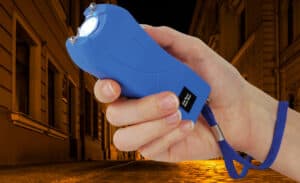
Delivers electrical charge that disrupts voluntary muscle control, causing temporary incapacitation. Requires 2-3 seconds of sustained contact for full effect.
Here’s where marketing and reality diverge significantly. You’ll see devices advertising “10 million volts!” as if voltage alone determines effectiveness. It doesn’t. What matters is the electrical charge measured in microcoulombs, and the ability to maintain contact long enough for the charge to work.
Effective Range: Contact distance only – you must touch the device to the attacker
Key Advantage: Works through clothing. Dramatic psychological deterrent (the crackling sound and visible arc). No chemical blowback concerns.
What It Requires From You:
-
- Close-quarters confrontation (you must be within arm’s reach)
-
- Physical contact for 2-3 seconds (harder than it sounds under stress)
-
- Sufficient strength to maintain contact if attacker is pulling away
-
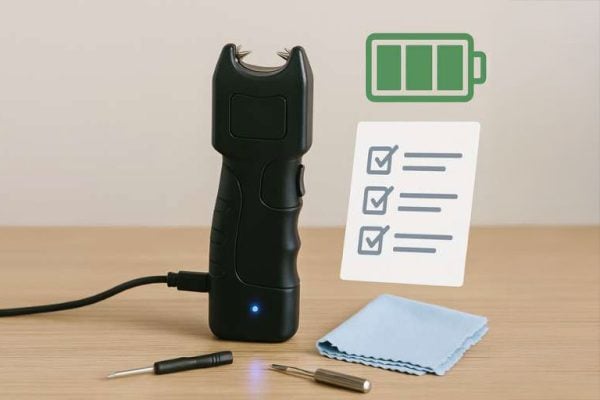
- Regular charging and battery maintenance
Best For: Home defense scenarios, people with limited mobility who can’t create distance, situations where you have a barrier or can control the encounter distance.
Legal Status: Restricted or prohibited in several states (Hawaii, Massachusetts, Rhode Island, New York, and New Jersey have various restrictions; always check local laws).
Research Reality: Law enforcement use-of-force studies show a 68% effectiveness rate – lower than pepper spray primarily because maintaining adequate contact under resistance is difficult, even for trained officers.
Personal Alarms: Audio Deterrents
How It Works
Emits 120-130 decibel sound when activated. Doesn’t physically stop an attacker but draws attention and triggers the criminal’s risk calculation.
The psychology here is interesting. Research shows that criminals operate on opportunity cost. The moment an alarm activates, the risk-reward calculation changes instantly. Attention equals risk. Risk equals flight.
Effective Range: Sound carries 300+ feet; psychological impact is immediate
Key Advantage: Requires no aim, no physical strength, no direct confrontation. Works equally well for all ages and physical abilities. Legal everywhere with no restrictions.
What It Requires From You:
-
- Quick access (must be easy to reach and activate)
-
- Faith that attention and noise will deter the attacker
-
- Understanding that it buys time and draws help, but doesn’t physically stop
Best For: Seniors, children, people uncomfortable with weapons, college students, anyone wanting the most universally legal option, situations where other people are within hearing distance.
Legal Status: Legal everywhere with no restrictions.
Research Finding: Urban Institute studies show 92% of attackers flee when an alarm activates – but effectiveness drops dramatically in isolated areas where no one will respond to the sound.
Telescopic & Stun Batons: Impact and Extended Reach Tools
How It Works
Telescopic batons are expandable metal rods (typically 16-26 inches when extended) used as impact weapons. Stun batons combine the extended reach with electrical charge capability at the tip. Both provide standoff distance greater than hand-held stun guns while maintaining impact weapon capability.
The extended reach is the key advantage here. Dr. William Lewinski’s research on force encounters shows that weapon reach directly correlates with defender advantage – each additional foot of reach increases reaction time and defensive options.
Effective Range:
-
- Telescopic batons: 16-26 inch reach (1.5-2 feet beyond arm’s length)
-
- Stun batons: Same reach plus electrical deterrent at contact point
Key Advantage: Extended reach provides distance advantage over contact-range tools while maintaining impact capability. Stun batons add electrical deterrent without requiring sustained contact like handheld stun guns. Strong psychological deterrent – visible weapon with clear defensive capability.
What It Requires From You:
-
- Training in proper use and strike targets (untrained use can be ineffective or dangerous)
-
- Physical strength and coordination to deploy and strike effectively
-
- Space to extend the baton (doesn’t work well in very confined spaces)
-
- Regular practice to maintain proficiency
-
- For stun batons: battery maintenance and understanding of electrical component functionality
Best For: Home defense (where legal), individuals with some training or willingness to train, situations where you have space to deploy, vehicle defense, those wanting extended reach without projectile weapons.
Legal Status: Highly restricted. Batons are illegal to carry in many states and municipalities. More restrictive than stun guns or pepper spray. California, Massachusetts, New York, and many cities prohibit civilian carry. Even where legal for possession, carry permits may be required.
Always verify local and state laws before purchasing.
Research Reality: Effectiveness data is limited because civilian use is restricted, but law enforcement studies show that impact weapons require training for effective deployment. Untrained users often strike ineffectively or telegraph strikes, allowing attackers to react. When used properly with training, batons provide significant defensive advantage due to extended reach.
Stun Baton Specific Considerations: Combining stun capability with baton reach sounds ideal, but research shows users often over-rely on the electrical component and neglect the impact training. The electrical charge at the tip has the same contact-time requirements as handheld stun guns (2-3 seconds), which is difficult to achieve in a dynamic encounter. The primary value is the reach and impact capability, with electrical charge as secondary deterrent.
The Distance Factor Nobody Talks About
Here’s where the research gets really interesting. When criminologists study successful self-defense outcomes, one variable predicts success better than any other:
the distance maintained between victim and attacker.
Research from the National Institute of Justice shows that defense tools effective from 10+ feet have success rates 40% higher than contact-range tools. This isn’t intuitive – we assume closer tools are more reliable because they seem more “direct.” But the data tells a different story.
Dr. David Kennedy, a criminologist at John Jay College, studied 1,200 assault cases and found that “the primary predictor of successful defense wasn’t the tool’s power or the victim’s training – it was the spatial buffer the tool provided.”
Distance creates decision time. Decision time reduces panic. Reduced panic improves effectiveness. It’s a cascade effect that shows up consistently across the research.
This is why pepper spray, with its 10-12 foot effective range, outperforms stun guns in real-world scenarios despite seeming “less powerful.” And it’s why batons, despite requiring closer engagement than spray, still provide meaningful advantage over handheld contact weapons – that additional 1.5-2 feet of reach matters more than most people realize.
The Questions That Determine Your Best Choice
Rather than asking “which is most powerful,” ask yourself these research-backed decision questions:
1. What distance can you realistically create?
If you’re typically in open areas (parking lots, streets, parks), distance-based tools like pepper spray make sense. If you’re in confined spaces (hallways, elevators, home interiors), extended-reach tools like batons may be more practical than handheld contact weapons, though still requiring more space than spray.
DOJ research shows that every foot of distance increases successful defense rates by approximately 7%. Distance matters more than stopping power.
2. How quickly can you deploy it?
Studies show you have 2-3 seconds from threat recognition to necessary response. Can you reach, grab, orient, and activate your chosen device in that time?
Test this honestly. Put your device where you’d actually carry it. Have someone time you retrieving and activating it. If it takes more than 3 seconds, you need either a different device or a different carry method.
Note: Telescopic batons require flicking or striking motion to extend, adding deployment time. Stun batons require both extension and activation. Practice is essential.
3. Will you actually carry it daily?
Research from the University of Chicago found that only 34% of self-defense device owners carry their device consistently. The rest leave it at home, in cars, or in bags they don’t always use.
The most effective device is worthless if it’s not with you. Batons, due to size (even collapsed) and legal restrictions, are rarely carried outside the home. This makes them primarily home defense tools rather than everyday carry options.
4. What’s legal where you actually go?
Some states restrict stun guns. Many buildings prohibit pepper spray. Airlines won’t allow either in carry-on bags.
Batons have the most restrictive legal status of any non-lethal option – illegal to carry in many jurisdictions even where ownership is legal.
If you travel frequently or work in restricted buildings, legal accessibility may determine your choice regardless of effectiveness preferences.
5. What are you comfortable using?
This is the question people avoid – but it’s crucial. Can you actually spray another person in the face? Can you maintain physical contact while someone is fighting you? Can you strike someone with an impact weapon?
Research shows that hesitation reduces effectiveness by 40%. If you’re not comfortable using a device type, that hesitation gives attackers precious seconds to react or overpower you.
Batons, particularly stun batons, require a higher threshold of commitment than spray devices. You’re choosing a tool that requires deliberate striking or sustained electrical contact. Honest self-assessment of your willingness to use impact force is critical.
What The Research Actually Recommends
After reviewing decades of crime data, effectiveness studies, and real-world assault outcomes, criminologists generally recommend a tiered approach:
Primary Defense: Distance-Based Tools
Pepper spray and gel rank highest in research for one simple reason – they work from a distance and have the highest success rate (85%). Distance creates time. Time creates options.
Backup/Supplemental: Audio Deterrents
Personal alarms work 92% of the time in populated areas and require no strength, training, or direct confrontation. They’re the most universally effective secondary tool.
Situational/Home Defense: Contact and Extended-Reach Tools
Stun guns, batons, and stun batons have specific scenarios where they excel – primarily home defense or situations where you can control distance and approach. Legal restrictions and training requirements make these less suitable for everyday carry.
Understanding Device Limitations
Every device type has limitations. Understanding these helps you choose realistically and avoid the trap of thinking any single device is a perfect solution.
Pepper Spray Limitations:
-
- Wind can affect trajectory (stream and gel minimize this)
-
- Cold temperatures can reduce pressure and range
-
- Expires and loses potency (replace every 2-4 years)
-
- Requires some aim, even with forgiving spray patterns
-
- Takes 2-5 seconds to work (not instant incapacitation)
-
- Can affect you if used in enclosed spaces
Stun Gun Limitations:
-
- Requires close contact (you’re already in the danger zone)
-
- Must maintain contact 2-3 seconds for full effect
-
- Very thick clothing can reduce effectiveness
-
- Battery-dependent (dead battery = useless device)
-
- Legal restrictions in many areas
-
- Psychological barrier to close-contact confrontation
Personal Alarm Limitations:
-
- Doesn’t physically stop attacker
-
- Effectiveness depends on people being nearby to respond
-
- Can be knocked away, muffled, or covered
-
- Less effective in isolated or noisy environments
-
- Some attackers may not be deterred by noise alone
Baton Limitations (Telescopic and Stun):
-
- Severe legal restrictions – illegal to carry in many jurisdictions
-
- Requires training for effective use (untrained strikes are often ineffective)
-
- Needs space to deploy – doesn’t work in very tight quarters
-
- Size makes everyday concealed carry impractical
-
- Can be taken away and used against you if you lack retention training
-
- Stun batons share all handheld stun gun limitations (battery, contact time required)
-
- Psychological and legal consequences of impact weapon use are significant
-
- More likely to escalate encounters than distance-based deterrents
-
- Requires regular practice to maintain proficiency
The Combination Approach
Here’s where it gets interesting: DOJ data shows that people carrying multiple device types have significantly higher successful defense rates than those relying on a single tool.
The most research-backed combination:
-
- Primary: Pepper spray or gel (distance-based stopping power)
-
- Secondary: Personal alarm (attention and deterrent)
-
- Home Defense (where legal): Baton or stun baton (extended reach, home-specific scenarios)
This gives you options across different scenarios, ranges, and threat levels. The pepper spray handles most situations outside the home. The alarm draws help and attention anywhere. The baton stays in the home for situations where you have space, time to retrieve it, and the defensive advantage of familiar territory.
Dr. Jennifer Carlson, who studies self-defense culture at the University of Arizona, puts it this way: “Single-tool reliance creates single-point failure. Layered defense provides options when circumstances vary.”
Why Popular Doesn’t Mean Effective
Here’s a puzzling market reality: stun guns outsell pepper spray roughly 3-to-1 in the consumer market. Yet research suggests the ratio should be reversed. Why the disconnect?
Part of it is perception. Stun guns
feel more powerful. 950,000 volts sounds impressive. Similarly, batons and stun batons
look more serious – they resemble law enforcement tools, creating an impression of professional-grade protection.
It triggers what behavioral economists call “numerical bias” and “authority bias” – bigger numbers and official-looking tools feel more protective, even when the science shows otherwise.
Part of it is marketing. Stun guns and batons typically have higher profit margins, so they receive more aggressive advertising and more prominent retail placement. This creates what researcher Robert Cialdini calls “social proof” – we see them everywhere, assume they must be best, and the cycle reinforces itself.
But the most interesting factor is what psychologist Barry Schwartz calls “the paradox of choice.” When consumers face too many options without clear evaluation criteria, they default to the option that
feels most decisive. Stun guns and batons feel decisive. They feel powerful. Pepper spray feels… messy. Uncertain. Less satisfying as a purchase decision.
None of this correlates with actual effectiveness data. But it explains the market perfectly.
Making Your Decision
The right self-defense device isn’t about maximum power. It’s about honest self-assessment across several dimensions:
Choose Pepper Spray/Gel If:
-
- You want the highest research-backed effectiveness rate
-
- You can practice deployment until it’s automatic
-
- You’re comfortable with the idea of spraying someone
-
- You’re typically in areas where you can create distance
-
- Legal restrictions aren’t a concern in your area
-
- You want something you can actually carry daily
Choose Personal Alarm If:
-
- You’re uncomfortable with physical confrontation tools
-
- You’re frequently in populated areas (campus, urban, residential)
-
- You want something legal everywhere, including planes
-
- Age or physical limitations make other tools impractical
-
- You want the easiest device to carry and deploy
Choose Stun Gun If:
-
- You’re primarily concerned with home defense
-
- You have mobility limitations that prevent creating distance
-
- Your state allows them legally
-
- You’re willing to train for close-quarters use
-
- You can maintain regular charging and maintenance
Choose Telescopic or Stun Baton If:
-
- You’re specifically focused on home defense (not carry)
-
- Your jurisdiction legally allows baton possession and use
-
- You’re willing to invest in proper training
-
- You have the physical capability to use impact weapons effectively
-
- You want extended reach advantage over handheld tools
-
- You understand and accept the legal implications of impact weapon use
-
- You have secure storage to prevent unauthorized access
Choose Combination If:
-
- You want options across different scenarios
-
- You’re serious about evidence-based preparation
-
- Budget allows for multiple devices
-
- You’ll actually carry and maintain multiple tools
-
- You understand that different tools serve different contexts (everyday carry vs. home defense)
The Pattern Behind Effective Protection
After reviewing thousands of assault scenarios, crime statistics, and effectiveness studies, a clear pattern emerges:
The people who successfully defend themselves aren’t necessarily the strongest, the fastest, or even the best trained. They’re the ones who made evidence-based decisions
before the crisis occurred.
They chose tools that research showed were effective. They understood the limitations. They practiced deployment. They based their preparation on data, not on how powerful something made them feel.
Dr. Gary Kleck, who has studied defensive tool use for decades, summarizes it this way: “Effective self-defense is 80% decision-making and preparation, 20% tool deployment. Most people focus exclusively on the 20%.”
Beyond the Device: What Actually Keeps You Safe
Here’s the uncomfortable truth that research consistently shows: the device itself matters less than the awareness and decision-making that surrounds it.
The National Crime Victimization Survey reveals that successful self-defense correlates most strongly with three factors:
-
- Early threat recognition – Noticing danger before it’s immediately upon you
-
- Practiced response – Having rehearsed deployment until it’s automatic
-
- Tool accessibility – Being able to reach the device in under 3 seconds
The actual device type ranked fourth in predictive value.
This doesn’t mean the device doesn’t matter. It means that even the most effective device can’t compensate for lack of awareness, practice, or accessibility.
A Research-Based Hierarchy
If you’re making an evidence-based decision about personal protection, the research points to a clear hierarchy:
Tier 1: Highest Effectiveness (85%+ success rate)
-
- Pepper spray/gel with 10+ foot range
-
- Personal alarms in populated areas
-
- Combination: alarm + spray
Tier 2: Situationally Effective (65-75% success rate)
-
- Stun guns (close quarters, controlled situations, home defense)
-
- Batons with training (home defense, extended reach advantage)
-
- Pepper gel (better than spray in wind, enclosed spaces)
Tier 3: Specialized/Limited Effectiveness Data (varies widely)
-
- Stun batons (requires training, legal restrictions, battery dependent)
-
- Keychain weapons (require contact and significant training)
-
- Whistles (insufficient volume, easily ignored)
-
- Phone apps (rely on cell service, phone access)
This hierarchy isn’t about what’s “better” in absolute terms – it’s about what the research shows works most consistently across the widest range of real-world scenarios.
Note that batons rank lower not because they’re inherently less effective when properly used, but because: (1) legal restrictions severely limit when and where they can be used, (2) effectiveness is heavily training-dependent, and (3) they’re impractical for everyday carry, limiting their utility to specific home defense scenarios.
Where to Go From Here
Understanding the research is just the beginning. The next steps are practical:
-
- Assess honestly which device type matches your life, comfort level, and carry habits
-
- Verify legal status especially for batons and stun guns in your specific jurisdiction
-
- Choose quality within your chosen category (we carry research-backed options for each type)
-
- Get training particularly for impact weapons and stun batons
-
- Practice deployment until it’s automatic (muscle memory matters under stress)
-
- Carry consistently (the best device is the one you actually have)
-
- Combine tools based on context (everyday carry vs. home defense)
At Revere Security, we’ve spent 20 years helping people make informed decisions about personal protection. We carry every category discussed here because we know that different tools serve different people and different situations.
The research doesn’t point to one perfect device. It points to informed decision-making based on realistic self-assessment.
That’s the advantage of evidence-based choice. It removes emotion and marketing from the equation and focuses on what actually works for your specific situation.
Questions about which device type is right for your situation? Our team has studied the research and helped thousands of people make informed decisions. Contact us at Revere Security – we’re here to help you understand the options, not just sell products.
Important Legal Note: Baton laws vary significantly by state and municipality. Before purchasing any baton (telescopic or stun), verify that possession and use are legal in your specific jurisdiction. When legal restrictions exist, we recommend focusing on pepper spray and personal alarms, which offer high effectiveness with fewer legal complications.
All effectiveness statistics cited are drawn from Department of Justice National Crime Victimization Surveys, published criminology research, and law enforcement use-of-force studies.