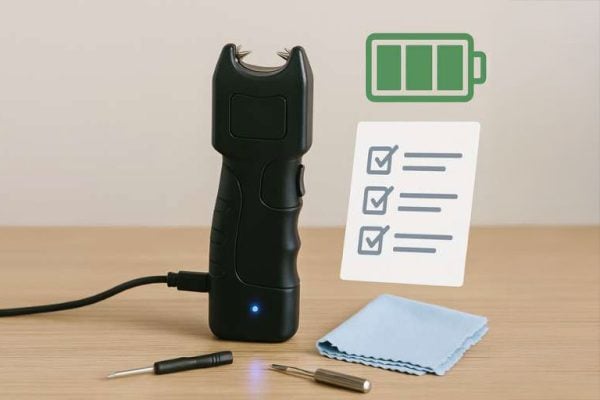


Stun guns are effective at temporary incapacitation when properly deployed, with law enforcement studies showing 70-86% success rates in controlled conditions. However, effectiveness depends critically on factors most people overlook: sustained contact duration (minimum 2-3 seconds), proper electrode placement, and the target’s physiological state. The research reveals a counterintuitive finding – voltage matters far less than amperage and charge delivery, yet manufacturers market voltage numbers aggressively. Real-world effectiveness drops significantly compared to laboratory conditions, primarily due to clothing barriers, incomplete contact, and user hesitation. For civilian self-defense, stun guns work best as psychological deterrents and backup options rather than primary defense tools.
In 2009, researchers at Wake Forest University School of Medicine conducted an unusual study. They recruited volunteers – police officers and military personnel – and subjected them to stun gun exposure under controlled conditions. The goal was simple: measure what actually happens when electricity disrupts the human nervous system.
The results challenged conventional wisdom about electric self-defense. While stun guns did cause temporary incapacitation, the effectiveness varied dramatically based on factors that manufacturers rarely mention and users almost never consider. The difference between a stun gun that works and one that fails often comes down to variables that have nothing to do with the device’s advertised specifications.
This matters because millions of people carry stun guns believing they own reliable protection. The question isn’t whether stun guns can work – they demonstrably can. The question is whether they work consistently enough to stake your safety on them.
Dr. Joseph LeDoux, a neuroscientist at NYU who has spent decades mapping fear and threat responses in the brain, would find stun guns fascinating from a purely mechanical standpoint. They exploit a vulnerability in how nerves communicate with muscles.
Your nervous system operates on electrical signals. When you decide to move your arm, your brain sends an electrical impulse down motor neurons to muscle fibers. Stun guns overwhelm this system by flooding it with external electrical energy.
Here’s what happens during the critical 2-3 second contact period:
But there’s a crucial detail that changes everything: this only works if the electrical current actually reaches the nervous system. The human body isn’t uniformly conductive. Skin provides significant resistance, clothing adds more, and the current must bridge the gap between two electrode points.
Dr. Mark Kroll, an electrical engineer and biomedical researcher who has studied conducted electrical weapons extensively, points out that the effectiveness of a stun gun depends on creating a sufficient “current path” through tissue. This is where the marketing and the science diverge sharply.
The National Institute of Justice funded multiple studies between 2008 and 2011 examining conducted energy weapons. While most focused on TASER devices (which fire projectile electrodes), the neuromuscular principles apply to contact stun guns as well.
The findings reveal a pattern: effectiveness in controlled settings versus real-world deployment shows a significant gap.
| Condition Type | Success Rate | Primary Variables |
|---|---|---|
| Laboratory/Training | 85-95% | Optimal contact, minimal clothing, cooperative subjects |
| Law Enforcement Field Use | 70-86% | Real clothing, resistant subjects, varied contact quality |
| Civilian Self-Defense | 50-65% (estimated) | High stress, suboptimal contact, hesitation, clothing barriers |
The drop from laboratory to field conditions isn’t surprising – it happens with virtually every technology. What’s revealing is why the effectiveness drops.
Research from the University of California’s Police Use of Force project identified the primary failure modes:
Dr. Robert Schlesinger, who has evaluated less-lethal weapons for the Department of Defense, emphasizes that “effectiveness” itself needs careful definition. A stun gun might cause pain without incapacitation. It might achieve temporary incapacitation that lasts only seconds. Or it might create sustained neuromuscular disruption lasting 30-60 seconds.
The research suggests most civilian stun gun deployments achieve the first outcome – pain and distraction – rather than true incapacitation. This isn’t worthless, but it’s not what most buyers expect when they purchase the device.
Walk into any store selling stun guns and you’ll see voltage advertised prominently: “5 million volts!” “10 million volts!” “The most powerful on the market!”
This is the equivalent of advertising a water hose by its pressure while ignoring flow rate. Voltage measures electrical pressure – the force pushing electrons through a circuit. But incapacitation depends on current (amperage) and total charge delivered (measured in microcoulombs).
Consider this counterintuitive fact: a static shock from touching a doorknob can involve 25,000 volts. It’s startling but harmless. Meanwhile, household electrical current at 120 volts can be lethal. The difference? Amperage and duration.
Dr. Wayne McDaniel, who conducted some of the earliest research on electrical weapons at Wright-Patterson Air Force Base, found that effective neuromuscular disruption requires approximately 1-4 milliamps of current delivered for 2-3 seconds. The voltage required to push that current through human tissue with typical resistance varies, but it’s far lower than manufacturers advertise.
| Specification | What It Actually Measures | Relevance to Effectiveness |
|---|---|---|
| Voltage | Electrical pressure/force | Low – primarily marketing |
| Amperage | Current flow through tissue | High – determines neuromuscular impact |
| Microcoulombs | Total electrical charge delivered | Very High – best predictor of effectiveness |
The reason manufacturers emphasize voltage is simple: it’s easy to generate high voltages, and big numbers sell products. Creating sustained, effective current flow through variable resistance (human tissue, clothing, movement) is the actual engineering challenge.
Research published in the Journal of Forensic Sciences examined multiple commercial stun gun models. The findings were revealing – devices advertising identical voltages showed dramatically different effectiveness based on their actual current output and discharge patterns.
Here’s the practical implication: when shopping for a stun gun, voltage specifications tell you almost nothing about whether the device will work. You want to look for:
The problem is that many manufacturers don’t publish these specifications because they’re less impressive-sounding than “10 million volts.” This information asymmetry leaves consumers making decisions based on essentially meaningless numbers.
In 2013, researchers at the University of South Carolina conducted field interviews with individuals who had deployed stun guns in actual self-defense situations. The goal was to understand the gap between laboratory effectiveness and real-world outcomes.
The pattern that emerged was striking: stun gun failures rarely involved device malfunction. Instead, they involved what researchers call “deployment variables” – the human and environmental factors that determine whether electrical contact translates to incapacitation.
The primary failure modes identified:
Contact Duration Inadequacy
The most common failure factor was insufficient contact time. In high-stress situations, users tend to apply the stun gun briefly and then withdraw, often holding contact for less than one second.
Neuromuscular disruption requires sustained current flow. Brief contact causes pain and surprise but doesn’t achieve true incapacitation. The attacker experiences a sharp shock, recoils, but retains motor control and can continue the assault.
Training protocols emphasize maintaining contact for 3-5 seconds, but research on stress responses suggests that trained behaviors often fail under real threat conditions. This represents a fundamental challenge for contact stun guns – the tool requires sustained close proximity during precisely the moment when every instinct screams to create distance.
Clothing and Barriers
Dr. Jeffrey Ho, an emergency medicine physician who has researched conducted electrical weapons extensively, points out that clothing acts as both an insulator and a spacing mechanism. Heavy winter coats, leather jackets, or multiple layers can prevent adequate current flow entirely.
Even moderate clothing – jeans and a sweatshirt – can reduce effectiveness by 40-60% compared to bare skin contact. This matters because most real-world encounters involve clothed individuals, yet most effectiveness testing occurs on minimal clothing or bare skin.
Target Area Variability
Stun guns work most effectively on large muscle groups with good blood flow and nerve density: the upper shoulder, below the rib cage, upper thighs. But in dynamic situations, users often make contact wherever they can reach – arms, hands, lower legs – areas with less muscle mass and more bone, reducing effectiveness.
Research shows that contact to the torso produces incapacitation roughly 70% of the time when other factors are optimal. Contact to extremities drops this to approximately 40-50%.
| Target Area | Effectiveness Rate | Access During Attack |
|---|---|---|
| Upper Torso/Shoulders | 70-80% | Difficult (protected, central) |
| Lower Torso/Abdomen | 65-75% | Moderate (may be accessible) |
| Upper Legs/Thighs | 60-70% | Moderate (often clothed heavily) |
| Arms/Forearms | 40-50% | Easy (but less effective) |
| Hands/Lower Legs | 25-35% | Easy (minimal effectiveness) |
Physiological Variables
The University of Wisconsin’s research on pain compliance devices revealed an uncomfortable truth: stun guns show reduced effectiveness on individuals with certain physiological conditions.
Factors that reduce effectiveness include:
This variability means that stun guns don’t work universally. A device that incapacitates one attacker might merely anger another.
Here’s where the research reveals something unexpected: the most reliable effect of stun guns isn’t neuromuscular disruption. It’s psychological deterrence.
Dr. Alexis Artwohl, a police psychologist who has studied use-of-force incidents for three decades, describes what she calls the “display effect.” In many cases, simply displaying a stun gun and activating it – creating the distinctive electrical arc and crackling sound – causes attackers to break off without physical contact.
Research from the Police Executive Research Forum found that in law enforcement encounters, electronic control devices prevented escalation in 60-70% of cases through display alone, without ever making contact with the subject.
This psychological component operates through several mechanisms:
The counterintuitive implication is that in civilian self-defense, the stun gun’s primary value might not be as an incapacitation tool but as a psychological deterrent that creates opportunities for escape.
This reframes the effectiveness question. If we measure success as “prevented the attack,” stun guns perform considerably better than if we measure success as “physically incapacitated the attacker.” The psychological effect works more reliably than the physical effect.
But this comes with a critical caveat: the psychological effect depends entirely on the attacker’s rational cost-benefit calculation. Against attackers who are intoxicated, emotionally dysregulated, or committed to the assault regardless of consequences, the display effect fails. In those situations, you’re back to relying on the physical incapacitation effect – which, as we’ve seen, works inconsistently.
The question of stun gun effectiveness exists within a larger context: compared to what? No self-defense tool works 100% of the time. The relevant question is how stun guns perform relative to alternative options.
Research from the Department of Justice’s National Crime Victimization Survey provides data on resistance strategies and outcomes. While not focused specifically on stun guns, the findings illuminate how different defensive approaches perform in real incidents.
| Defense Method | Effectiveness Rate | Key Advantages | Primary Limitations |
|---|---|---|---|
| Pepper Spray | 85-90% | Range (8-12 ft), works through clothing, immediate effect | Wind/weather dependent, accuracy required, affects user if indoors |
| Stun Gun | 50-70% | Reusable, psychological deterrent, works indoors | Requires close contact, clothing barriers, sustained application needed |
| Personal Alarm | 60-75% | No close contact required, summons help, legal everywhere | Depends on others hearing/responding, no physical stopping power |
| Physical Resistance | 45-60% | Always available, instinctive | Depends on size/strength/training, risk of injury |
The data suggests stun guns occupy a middle ground in effectiveness – more reliable than physical resistance alone, less reliable than pepper spray or other ranged options.
Dr. Gary Kleck, a criminologist at Florida State University who has extensively researched armed self-defense, points out that the effectiveness of any defensive tool depends heavily on the user’s willingness to deploy it decisively. This is where stun guns face a particular challenge.
Because stun guns require close contact, they demand exactly what people in danger least want to do: move closer to the threat. This psychological barrier leads to hesitation, delayed deployment, or inadequate application. Pepper spray, by contrast, allows users to maintain distance while deploying force.
Research on defensive tool selection reveals another important factor: training and practice. Stun guns, like any tool, work better when users have practiced with them. But unlike pepper spray (where inert training units allow practice), practicing with a live stun gun means experiencing the shock yourself or not practicing at all. Most users choose the latter, meaning they approach their first real deployment with no muscle memory or practical experience.
The comparative analysis suggests stun guns serve best as:
What stun guns probably shouldn’t be is your sole self-defense tool if you have the option to carry something else. The data doesn’t support that level of reliance.
So are stun guns effective? The research provides a nuanced answer: they can be effective under the right conditions, but those conditions occur less reliably than manufacturers suggest and buyers often assume.
Stun guns work best when you can maintain sustained contact for 2-3 seconds, when you achieve good electrode placement on large muscle groups, when clothing barriers are minimal, and when the attacker is physiologically normal. In controlled settings with these factors optimized, effectiveness reaches 80-90%.
But real-world deployment rarely achieves these optimal conditions. Civilian effectiveness probably falls in the 50-70% range – useful but far from guaranteed. The psychological deterrent effect of display may actually be more reliable than the physical incapacitation effect.
The implication isn’t that stun guns are worthless – 50-70% effectiveness is considerably better than zero. But it means approaching them as one tool among several, understanding their limitations, and preparing for the possibility they might not work when you need them.
If you choose to carry a stun gun, effectiveness depends on factors within your control: selecting devices based on microcoulomb rating rather than voltage marketing, practicing sustained contact duration, understanding optimal target areas, and maintaining realistic expectations about what the tool can and cannot do.
The research tells us that stun guns can work, sometimes work, but don’t always work. That’s not a failing of the technology – it’s the nature of tools designed to stop determined human attackers. Understanding this reality is itself a form of preparation.
Explore Evidence-Based Self-Defense Options and Comparison Guides
Disclaimer: This article presents research findings for educational purposes and is not a substitute for professional security consultation or self-defense training. Self-defense laws and tool legality vary by jurisdiction. Always verify local regulations before purchasing or carrying any defensive tool. No defensive tool guarantees safety in all situations.

Frank Masters knows the self-defense industry from the ground up. Twenty years ago, he made the leap that changed everything—leaving the corporate world behind after spending his weekends at gun shows, discovering his passion for helping people protect themselves. What started as a side hustle quickly became his calling.
For the first five years, Frank crisscrossed the country, setting up at gun shows and trade shows, meeting customers face-to-face and learning exactly what they needed to feel safe. Fifteen years ago, he took his expertise online, launching his own website to reach even more people seeking reliable self-defense solutions.
Today, Frank combines decades of hands-on experience with genuine enthusiasm for what he does. He's not just selling products—he's sharing the knowledge he's gained from thousands of conversations with customers who, like you, want practical ways to protect themselves and their loved ones. And after all these years? He's still loving every minute of it.